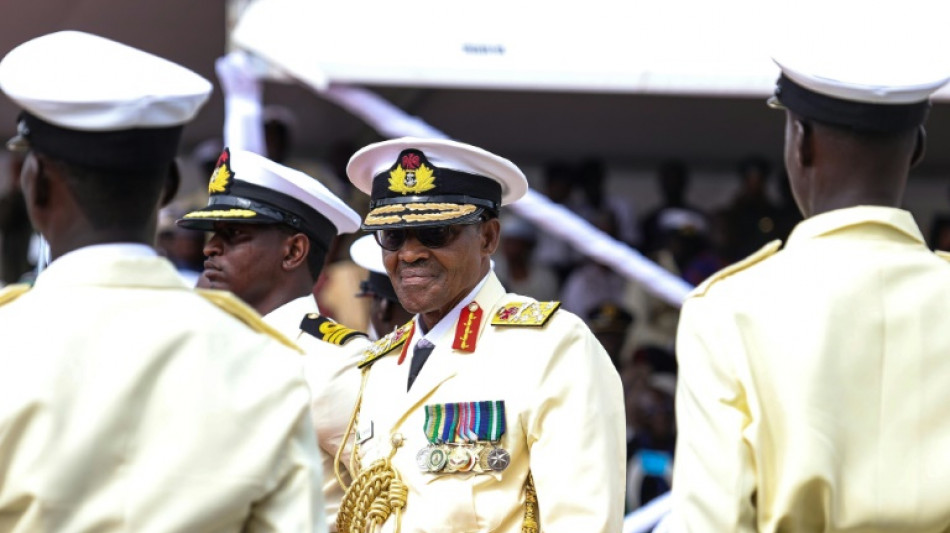
Nigeria's outgoing president opens major oil plant / Photo: © AFP
Nigeria's President Muhammadu Buhari on Monday commissioned an oil plant billed as Africa's largest oil refinery, after years of delays and a week before stepping down from office.
Built by Africa's richest person Aliko Dangote in the commercial hub of Lagos, the refinery should begin operations in June with the first products expected on the market by August though some analysts said it could be later.
Once at full capacity, it will have the ability to process 650,000 barrels a day, according to the company.
Buhari -- who steps down on May 29 after eight years in office -- described the project as "a notable milestone" and "a game changer for the downstream petroleum products market, not only in Nigeria but for the entire African continent."
The presidents of Ghana, Niger, Togo, Senegal and a representative of the Chadian leader were present at the commissioning.
The refinery is expected to meet Nigeria's domestic demand as well as serve global markets, Dangote said.
"Once our plant is fully commissioned... we expect that at least 40 percent of the capacity will be available for export, and this will result in significant foreign exchange entering the country," said Dangote.
For decades, Africa's most populous nation and one of the continent's largest crude producers has depended on fuel imports to meet local demand because of under-performing state-run refineries.
Nigeria swaps crude worth billions of dollars for gasoline that it then subsidises for its domestic market.
It has caused a huge drain on foreign exchange at a time of dwindling oil revenue following the coronavirus pandemic and the Russia-Ukraine war.
- Costly subsidies -
For analyst Tunde Leye, from the Lagos-based SBM Intelligence consultancy, it was "important for Buhari to inaugurate (the plant) before leaving power" but he doesn't expect the refinery to be fully operational before the end of 2024.
Amaka Anku, Eurasia Group's Africa head, was more optimistic about the timeline.
"It typically takes six to nine months to get to full operations," she told AFP, which would be "by the end of the year or next year."
She said the "significant" project would also have a beneficial impact on a range of industries that need refined crude products, from pharmaceuticals to construction.
Both analysts noted however that Dangote's refinery will not make the price of petroleum products cheaper but could present an opportunity for the government to remove costly subsidies and address revenue shortages.
"I think that this is a significant opportunity for the government to support its goal of removing subsidies," said Anku, but "there's a political decision to be made."
President-elect Bola Tinubu -- whose February victory is being contested by the opposition -- has said that he would remove subsidies once in office. He was not present at the commissioning.
The refinery could also help improve transparency in the oil sector, according to Anku.
"Dangote is a publicly listed company so it will be publishing information about how much crude it is purchasing and petroleum it is selling," she said, noting it as an improvement compared to the current situation where "we don't have a lot of transparency."
The current opaque system has fostered corruption according to analysts, and limited the government's ability to invest in key areas like education and healthcare.
The new facility, lying on 2,635 hectares (6,500 acres) of land at the Lekki Free Zone, was initially estimated to cost $9bn dollars but some $18.5bn has been spent to complete it, according to the company.
Some 1,100 kilometres (about 680 miles) of subsea pipelines have been laid to link the oil-rich Niger Delta to the complex.
The pipelines are also expected to create a corridor for the evacuation of trapped gas from offshore platforms and allow for the monetisation of the product.
Also on the massive complex is a $2 billion fertiliser plant with a three million tonnes per annum capacity.
More than 100,000 direct and indirect jobs are expected to be created through the project, the Lagos State government has said.
S.Arnold--TNT