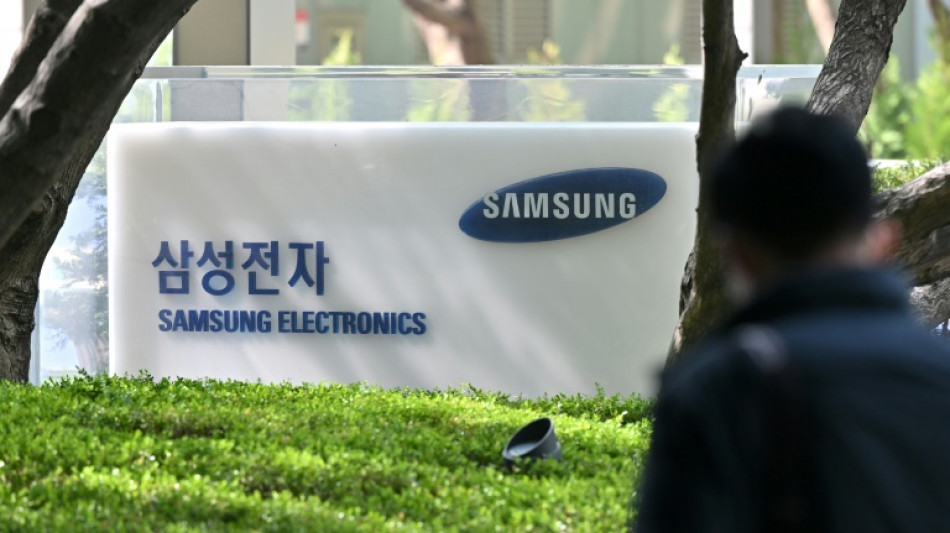
Samsung Electronics logs worst quarterly earnings in 14 years / Photo: © AFP/File
Samsung Electronics on Thursday reported its worst quarterly profits in 14 years, blaming slowing consumer spending on electronics and a global microchip glut that hit its core memory business.
The South Korean company -- one of the world's largest makers of memory chips and smartphones -- said in a statement that operating profit fell 640 billion won ($478.6 million) -- down 95 percent from a year earlier.
The company's first-quarter net income fell 86.1 percent to 1.57 trillion won, and sales dropped 18 percent to 63.75 trillion won.
The company said that "overall consumer spending slowed amid the uncertain global macroeconomic environment".
Samsung also blamed weakening demand for memory chips -- which usually generate about half the firm's profits -- and falling chip prices.
Samsung's chip division reported 4.58 trillion won in losses, its first operating loss since 2009 -- when the world was emerging from the 2008 financial crisis.
It said this was due to "continued price declines and an increased valuation loss ... amid weakening sentiment and continued impacts of inventory adjustments by customers caused by prolonged external uncertainties," the company said.
Demand for memory was "expected to gradually recover" in the second half of 2023, "amid projections that customer inventory levels will have declined."
The firm is the flagship subsidiary of the giant Samsung Group, by far the largest of the family-controlled conglomerates that dominate business in Asia's fourth-largest economy.
The first-quarter drop is the third consecutive margin squeeze for Samsung, which saw a 70 percent fall in operating profits in the fourth quarter on-year.
- Scaling back production -
Korean chipmakers -- led by Samsung -- have enjoyed record profits in recent years as prices for their products soared, but the global economic slowdown has dealt a blow to memory sales.
Demand swelled during the pandemic as consumers bought new computers and smartphones during lockdowns, prompting chip makers to ramp up production.
But demand quickly diminished as lockdowns lifted and weakened further in the face of soaring inflation and rising interest rates.
Samsung said this month it will scale back memory chip production at a "meaningful" level to address the oversupply, an unusual move by the firm, which previously said it would make only small adjustments.
South Korean chip maker SK Hynix and Micron Technology of the United States have also reduced production.
Samsung's "active" efforts to get out of the inventory rut were "positively evaluated" considering its effect on market sentiment and demand for memory chips, said a report released by Eugene Investment & Futures.
"Even if the pace of recovery for demand remains slow, the semiconductor industry is highly likely to recover in the second half if cooperation among the chip makers on production cuts goes well," it added.
While solid sales of its new flagship Galaxy 23 smartphones helped offset deficits in the chip sector in the first quarter, analysts expect conditions in the April to July period to worsen and even lead to Samsung's first profit loss since 2008.
"We cannot rule out the possibility of Samsung swinging to the red when the effect of new smartphones diminishes," Hwang Min-seong, an analyst at Samsung Securities, told Yonhap news agency.
The recent drop in profits has not deterred Samsung from making bold investments -- in March, it unveiled plans to contribute $227 billion over the next two decades to building the world's largest chip centre in Yongin, south of Seoul.
B.Scott--TNT