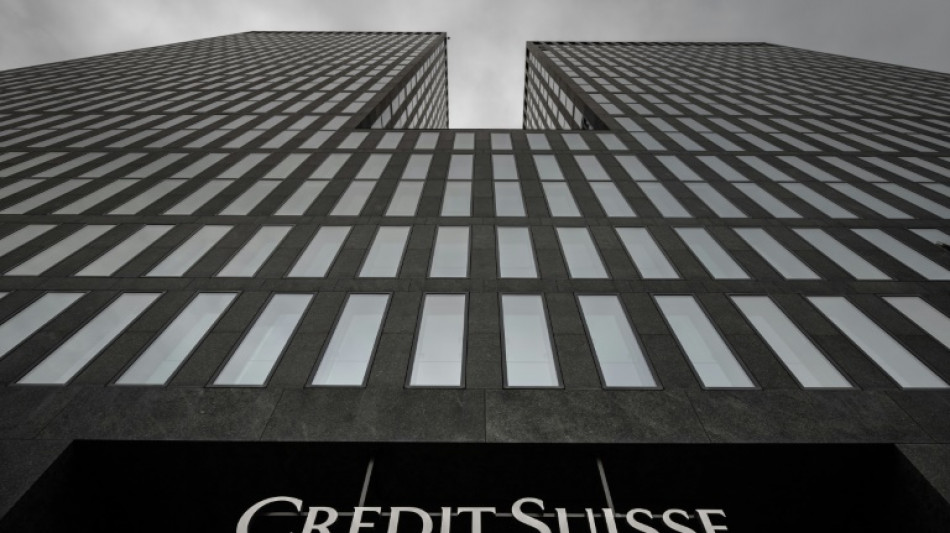
Over $68 bn withdrawn from Credit Suisse ahead of UBS takeover / Photo: © AFP/File
Tens of billions were withdrawn from Credit Suisse in the first three months of 2023, but its profit swelled as the bank's high-risk debts were wiped out in an emergency takeover by UBS.
Switzerland's long-time second largest bank saw 61.2 billion Swiss francs ($68.6 billion) withdrawn in the first quarter alone, it said Monday in what is likely its final quarterly report before it is swallowed by its larger domestic rival, UBS.
Investors had been eagerly awaiting the results as they seek clues to the magnitude of the challenges facing UBS, which was strongarmed last month by Swiss authorities into the mega-merger.
Credit Suisse said the "significant net asset outflows" were particularly heavy in the second half of March, as it was engulfed by panic amid the hastily arranged takeover by its larger domestic competitor.
"These outflows have moderated but have not yet reversed as of April 24, 2023," the bank said in its earnings statement.
At the same time, the bank said it saw its net profit swell to 12.4 billion francs, up from a significant loss a year earlier, after holders of high-risk Credit Suisse debt were wiped out in the emergency takeover deal.
Swiss authorities required that close to 16 billion Swiss francs ($17.9 billion) in so-called additional tier 1 (AT1) bonds be rendered worthless before Switzerland's two biggest banks united.
The order by the Swiss Financial Market Supervisory Authority (FINMA) infuriated bondholders, and a number of them have begun launching legal action against the regulator.
- 'Substantial' losses expected -
Credit Suisse said its quarterly results were also boosted by the 700-million sale of a significant part of its Securitized Products Group to Apollo Global Management.
But despite this, on an adjusted basis, the bank said it nonetheless suffered a pre-tax loss for the quarter of 1.3 billion Swiss francs.
The bank, which last October launched a vast restructuring plan including carving out its investment arm, said that branch had suffered an adjusted pre-tax loss of 337 million in the first quarter.
And it warned that "in light of the merger announcement, the adverse revenue impact from the previously disclosed exit from non-core businesses and exposures, restructuring charges and funding costs", it expected to see a "substantial" pre-tax losses in its investment bank unit and overall in the second quarter and full year of 2023.
Monday's quarterly report could meanwhile be Credit Suisse's last one, depending on how long it takes to finalise the merger with UBS.
- 'Bad shape' -
Credit Suisse suffered a string of scandals over the past several years, and after the collapse of three US regional banks unleashed market panic, it was left looking like the weakest link in the chain.
Over the course of a nerve-wracking weekend, Swiss authorities organised an emergency rescue, pressuring UBS to agree to a $3.25-billion mega merger on the evening of March 19.
Justifying the move to parliament earlier this month, Swiss President Alain Berset said that "without intervention, Credit Suisse would have found itself, in all likelihood, in default on March 20 or 21".
In 2022, Credit Suisse suffered a 7.3-billion-franc loss, with 110.5 billion francs in outflows in the final quarter alone.
That stood in stark contrast to the $7.6 billion profit raked in by UBS last year.
UBS is due to publish its first quarter results on Tuesday.
Analysts with the Zurich Cantonal Bank (ZKB) acknowledged that UBS's results would be "a sideshow", with all eyes on "the uncertainties surrounding the planned merger with Credit Suisse".
Vontobel analyst Andreas Venditti agreed, warning in a research note that Credit Suisse's report "reveals the bad shape the firm is in".
"UBS undoubtedly faces a major (and urgent) task in deeply restructuring its former competitor," he said.
L.Graham--TNT