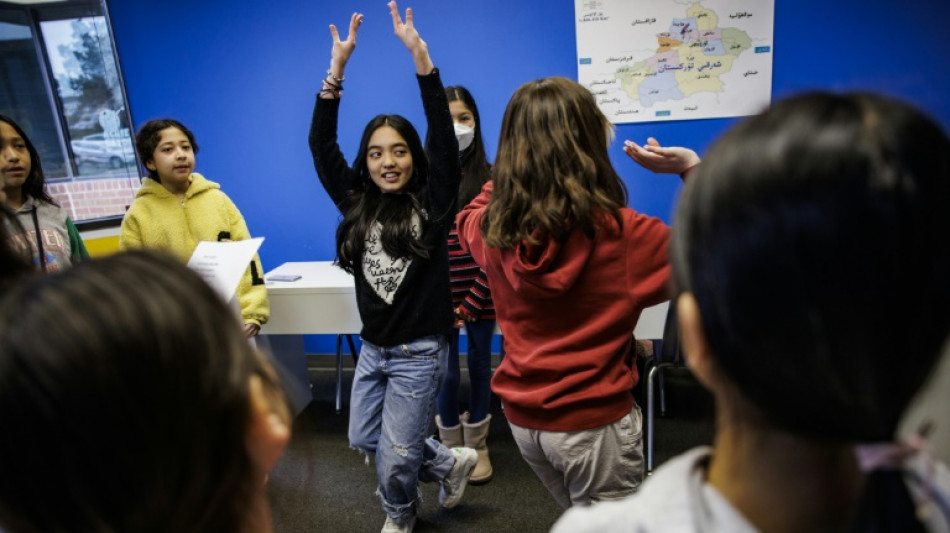
Learning a language for loss: Uyghur school in US offers link to homeland / Photo: © AFP
At a weekend school in the US state of Virginia, language classes serve a dual purpose for young Uyghurs -- cultural preservation, and access to vocabulary to discuss the plight of relatives in China.
Classes at the Ana Care and Education center strive to be nonpolitical, said Irade Kashgary, 29, who cofounded the school with her mother Sureyya.
But in recent times, older students who want to talk about current affairs can also "safely discuss what's happening, how they're impacted," she added.
The school teaches Uyghur language, history and culture on Sundays, and is among a network of US groups connecting the diaspora.
Many Uyghurs in America migrated or fled from the northwestern Xinjiang region in China, which some refer to as East Turkestan. And it has become increasingly tough to maintain any ties with their homeland as China tightens its grip on the area.
Beijing is accused of widespread human rights abuses in the region and detaining more than a million Uyghur and other Muslim minorities in re-education camps -- allegations that officials vehemently deny.
The United States and lawmakers in some Western countries have said the actions amount to genocide.
For Kashgary and her mother, the school started small in 2017, expanding as more people got disconnected from relatives.
"That sense of loss ignited this need to retain and preserve our culture and our language," she told AFP.
- Dangerous to phone home -
"As the situation continued to grow worse... we have seen an increase of people," Kashgary said.
"Now (children) don't even have cousins and aunts and uncles to really have a conversation with, to keep the language alive," she said.
More people have been getting disconnected from families as China expanded a crackdown in the region since 2017, ostensibly to strike back against alleged terrorism.
The school began with around 20 students and now has about 100.
Virginia has one of the largest Uyghur populations in the United States, with at least 3,000 Uyghur speakers, according to Uyghur American Association estimates.
Kashgary said some move to the area for its community.
While the school steers clear of activism, it introduced a class this year for older students to discuss present-day issues while learning the Uyghur language.
"We want to talk to our relatives by phone or some other online ways, but it's not possible because if we connect... (they) may be detained," said Savut Kasim, 49, whose children attend the school.
"It's happening, genocide for Uyghur people in East Turkestan... So, we try to keep our language by all means," he said.
Since 2012, bilingual Mandarin-Uyghur education was gradually applied in Xinjiang schools. Previously, classes were mostly taught in Uyghur and other minority languages.
- Can't go back -
Attending Uyghur school in California helped Muzart read and write better in the language, bringing him closer to his culture.
"I wasn't able to grow up with such a tight-knit community but thankfully the future generation will be able to," said the 18-year-old who wanted to be known only by his first name.
Now, the first-generation American volunteers with a summer program in the western state.
"We try to speak Uyghur only to the kids," he said. "Youth are realizing... how important it is to preserve our culture."
One of them is Zilala Mamat, an 18-year-old university student in Michigan who cofounded a network for Uyghur youth in 2021, connecting people through events and social media.
"That was something missing within our community," she said.
"A lot of Uyghur youth have not been able to go back to East Turkestan or even meet anyone from (there) because of the human rights abuses," she added.
- Identity struggles -
"We're survivors of genocide. Unlike people who are immigrants of their own will, it's different for us," said university student Asena Izgil, 21.
She said it was in 2017 when the situation worsened.
"Friends and relatives, people we know got in trouble. They either went to camps or they went to jail," added the Urumqi native.
"That really concerned my dad... we decided to leave."
Her parents feel a duty to maintain their culture, and named her brother after a river in their homeland.
But many youth struggle with identity growing up in America.
"After the genocide began, the whole world, the community, is expecting them to act like Uyghurs," said Izgil.
As a result, some avoid group activities, making outreach challenging.
For Izgil, it is a battle worth fighting.
"We eat Uyghur food, my mum teaches us to cook Uyghur food, we celebrate all the Uyghur holidays, we do all the religious practices that we couldn't do back in our homeland -- freely with no fear," she said.
F.Harris--TNT