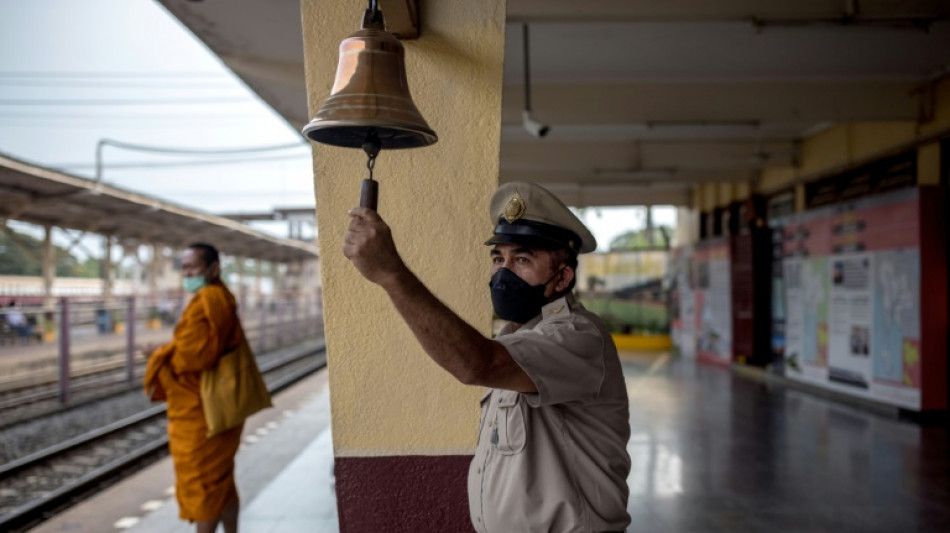
Thailand's China-built high-speed rail, on track but delayed / Photo: © AFP
One of Thailand's oldest railway stations is facing demolition as the kingdom presses ahead with a long-delayed Chinese-backed high-speed line that has caused unease about lost heritage and closer ties to Beijing.
Concrete piers supporting the new elevated track tower over bright green rice paddies, cutting a strip through a quiet corner of Thailand's poor, rural northeast.
The $5.4-billion line aims to connect Bangkok to Kunming in China via Laos by 2028 -- another piece in Beijing's vast "Belt and Road" infrastructure initiative that sprawls across Asia.
Prime Minister Prayut Chan-o-Cha, facing a tough battle in next month's general election, has championed the 600-kilometre (373-mile) railway as a way to boost the economy through trade with China.
Thailand already has nearly 5,000 km of railway but the run-down network has long driven people to favour travel by road -- despite the extremely high accident rate.
When the line is complete, Chinese-made trains will run from Bangkok to Nong Khai, on the Mekong River border with Laos, at up to 250 km/h.
- Heritage battle -
One of the old stations lined up for the wrecking ball is in Nakhon Ratchasima, the main city in the northeast, three and a half hours by road from Bangkok -- or nearly five by regular train.
Inaugurated by King Rama V in 1900, the old station is fraying at the edges, with stray dogs snoozing under tatty wooden benches -- but from the walls, colourful posters trumpet the bright future of high-speed travel.
The State Railway of Thailand -- which did not respond to AFP's requests for comment -- plans to replace it with a new station 16 times bigger, built in glass and steel.
But there is resistance from local campaigners who do not want to see a piece of Thai history -- and one with royal connections -- fall to the bulldozers.
"We are not against the high-speed train project, but we want to show that the old and the new can co-exist," Werapol Chongjareonjai, the chair of an association of Siamese architects in the northeast told AFP.
Werapol wants to turn the site into a tourist spot by shifting some pillars by a few metres so the new station can be built alongside the old one.
Demolition work was due to begin at the start of the year but Werapol and his fellow activists have managed to delay it.
With the general election looming on May 14, they hope to string the process out further as officials are reluctant to take decisions until the poll is settled.
"We will try to take advantage of the elections to talk to the candidates," he added.
- 'David and Goliath' -
It is the latest in a series of delays to the project, first proposed to the Thai government back in 2010.
The junta led by Prayut pushed closer ties with China, leading some to fear that Thailand was abandoning its policy of trying to balance relations with Washington and Beijing.
Eventually, Prayut signed a deal for Thailand to cover all project expenditures, while using China-advised technology.
Benjamin Zawacki, author of "Thailand: Shifting Ground between the US and a Rising China", says the long delays show that Bangkok is less keen on the project than Beijing, wary of getting drawn too deep into the Belt and Road web.
"The fact that it is taking this long is some evidence that Thais are not overwhelmingly enthusiastic about it," he said.
High debts to China have been a constant worry for countries involved in the Belt and Road initiative, and the fact that Thailand is paying for the railway marks it out from neighbouring Laos, where the Vientiane-Boten line opened in 2021.
There, Beijing paid 70 percent of costs and much of the Laos government's contribution came from loans from Chinese banks.
Suthiphand Chirathivat, professor of economics at Chulalongkorn University in Bangkok, said the delays had helped Thailand take ownership of the rail project.
"This is now a Thai project working with China. We put our money, it is our own soil," he told AFP.
"China is a Goliath, and Thailand a David. David has to take a stand."
A.Robinson--TNT