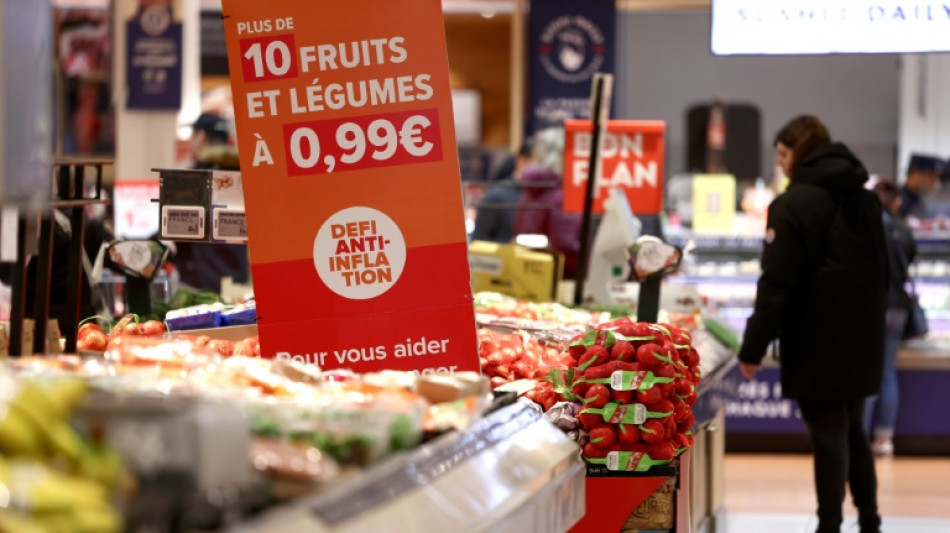
Eurozone and US inflation slow, bringing respite to policymakers / Photo: © AFP/File
Eurozone inflation slowed sharply in March while US price increases eased last month as well, official data showed Friday, offering some relief to policymakers.
The data released on both sides of the Atlantic will provide central banks some respite as they carefully balance taming inflation with interest rate rises, against the risks that more hikes could hurt their banking sectors.
Consumer prices rose by 6.9 percent on an annual basis in the eurozone, down from 8.5 percent in February, according to the European Union's statistics agency.
It is the lowest rate recorded in a year, and a lower figure than analysts expected as well.
But the eurozone's core inflation, which excludes volatile food and energy prices, edged up to 5.7 percent in March from 5.6 percent a month earlier.
In the US, the Federal Reserve's preferred measure of inflation slowed in February also, according to Commerce Department data released Friday.
The annual personal consumption expenditures price index (PCE) slowed to 5 percent in February from 5.3 percent a month earlier, with increases recorded in the cost of food, energy and goods.
But core PCE, which excludes volatile food and energy costs, only slowed slightly to log an annual increase of 4.6 percent in February, down from 4.7 percent in January.
In a statement released Friday, US President Joe Biden said: "We are making progress in the fight against inflation."
- Inflation still too high -
On both sides, however, inflation still remains well above the central banks' two-percent targets.
The Fed and European Central Bank have both raised interest rates repeatedly to tame red-hot inflation, although recent turbulence in the banking sector has added some complications.
In the eurozone, inflation remains elevated despite falling from a peak of 10.6 percent in October.
But in March, energy prices fell by 0.9 percent after rising by 13.7 percent in February, according to Eurostat, the first drop since February 2021.
While Russia's invasion of Ukraine sent oil and gas prices soaring last year, they have become more stable in recent months, helped also by mild weather.
Food and drink prices rose by 15.4 percent in March, compared with 15 percent in the previous month, it added.
"This indicates that price pressures remain high for the moment, although this should improve in the coming months," ING senior eurozone economist Bert Colijn said.
- More rate rises expected -
After nine interest rate increases since March 2022, Fed chair Jerome Powell suggested the US central bank may only raise rates once more before bringing its current hiking cycle to a halt.
Eurozone analysts also expect to see further rate rises to tackle rising prices.
"Descending headline inflation thanks to cooling energy prices will not be enough for the ECB to stop tightening, as policymakers are looking for clear signs of core inflation easing," said Riccardo Marcelli Fabiani, economist at Oxford Economics.
ING's Colijn added in a note: "The potential for core inflation to remain stickier than hoped will be the main reason for the ECB to continue to hike in the near term. We expect another 25bp hike in May and another in June."
Inflation also slowed in some of Europe's biggest economies in March, fueling hopes that the region is past the worst price increases.
In Germany, annual price growth slowed to 7.4 percent in March from 8.7 percent in the first two months of 2022.
The annual inflation rate came in at 5.6 percent in France in March, compared to 6.3 percent the previous month.
The slowdown was more pronounced in Spain, with inflation coming in at 3.3 percent compared to six percent in February.
Among the 20 countries that use the euro, Luxembourg had the lowest inflation rate in February at 3.0 percent, Eurostat said.
According to other Eurostat data published Friday, the unemployment rate in the eurozone remained stable in February at 6.6 percent.
S.Ross--TNT