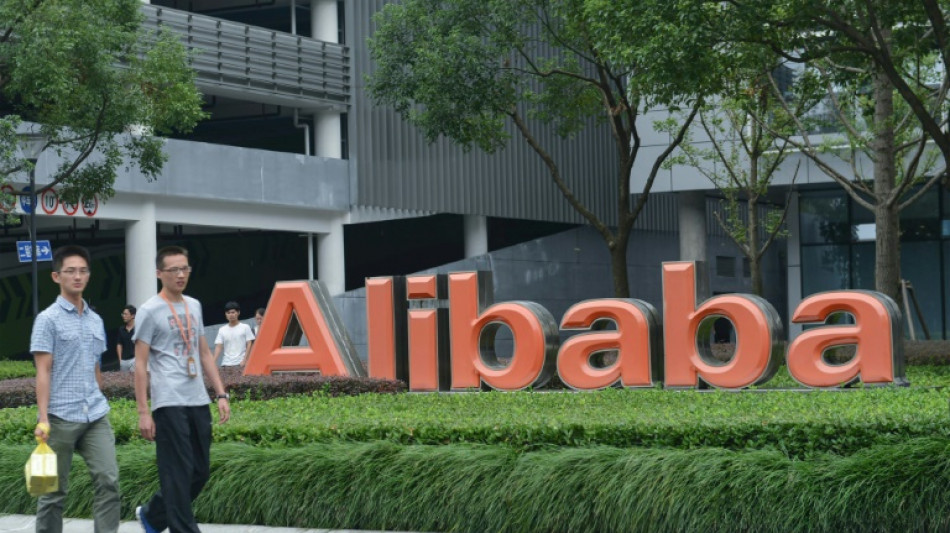
Alibaba's overhaul: a 'smart' move after China crackdown / Photo: © AFP/File
Alibaba, China's biggest e-commerce company, has announced plans to split its business into six groups, in one of the most significant overhauls of a leading Chinese tech firm to date.
Below is what we know about this major shake-up:
What is happening to Alibaba?
Alibaba has said it will split its $220 billion empire into six businesses: focusing on logistics, cloud computing, entertainment, e-commerce, and two others offering services to global businesses.
Its logistics arm, Cainiao, helped deliver Chinese vaccines around the world during the Covid-19 pandemic.
Its cloud computing service was seen as a rival to Amazon until last year, when the Chinese government suspended a partnership with Alibaba, saying the company failed to quickly address cybersecurity vulnerabilities.
The entertainment unit runs Youku, one of China's biggest online video-sharing platforms.
Each unit will be managed by its own CEO and board of directors, allowing them to raise their own funds and pursue public listing plans separately.
Alibaba itself will only retain full ownership of its China e-commerce unit, Taobao Tmall Commerce Group.
The company described the restructuring as the "most significant" organisational overhaul in its 24-year history.
"The market is the best litmus test, and each business group and company can pursue independent fundraising and IPOs when they are ready," CEO Daniel Zhang said.
What's behind the overhaul?
Dividing the monolith into smaller units could make Alibaba more nimble and help insulate parts of the business from government crackdowns, analysts said.
"Revenue in Alibaba's core e-commerce business declined last year, because pressure from competition was... high," said Li Chengdong, founder of Dolphin, a technology-focused think-tank in Beijing.
"By splitting up, Taobao actually becomes a little lighter and can cope with... new types of competition."
Alibaba has been a prime target of China's regulatory crackdown, prompted in part by Beijing's fears that too much power and capital had been accrued by a small number of tech behemoths.
"Splitting things up is a smart move," said Jeffrey Towson, partner at Techmoat consulting.
"Now (Alibaba) won't be seen as such a dominant, solitary player," he added.
"If there is a political issue with one part, it won't hit the rest of the business."
Why is it happening now?
Signs now suggest the crackdown from regulators may be easing.
Officials at China's annual rubber-stamp parliamentary session this month pledged more support for the private sector, ravaged by almost three years of harsh Covid restrictions.
Alibaba's overhaul comes as its talismanic co-founder, Jack Ma, returned to China this week after an extended absence from the public eye.
Ma has kept a low profile since late 2020, when a speech he made attacking Chinese regulators was widely believed to have provoked Beijing into pulling a mammoth IPO by Alibaba's affiliate Ant Group.
In January, Ant Group said Jack Ma no longer held controlling rights in the company -- a move analysts speculated might have helped pull Ant and Alibaba out of the regulatory doghouse.
Will others follow suit?
Chinese tech shares rallied in Hong Kong on Wednesday on speculation that other big players could follow Alibaba's example.
The tech giant's fate has been held up as a cautionary tale for others also caught in Beijing's crosshairs -- and its restructuring plan could serve as a template for its peers.
"Investors could get hyped on the positive side in the short term," Willer Chen, senior research analyst at Forsyth Barr Asia Ltd, told Bloomberg News.
"Alibaba's shakeup plan may also lead investors to think of the potential for other tech firms like Tencent to follow suit."
According to Towson, Alibaba has always been "ahead of the curve".
"Many are looking at whether other companies will now follow its path. But I don't know of anyone doing it right now."
O.Nicholson--TNT