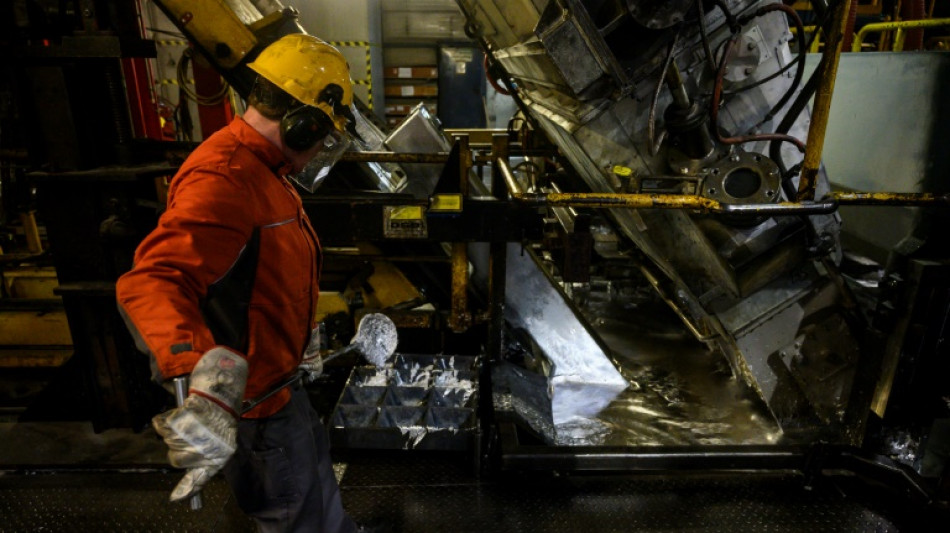
Germany to open its doors as labour shortage bites / Photo: © AFP/File
An apprenticeship at a steelmaker brought Steven Maillot from the French island of Reunion in the Indian Ocean to Eisenhuettenstadt in Germany, a stone's throw from the Polish border.
Better pay and better job prospects were the deciding factors for Maillot -- a relief for ArcelorMittal, where the group's Germany chief Reiner Blaschek acknowledged that attracting young trainees like the 23-year-old is becoming "increasingly difficult".
A shortage of skilled workers has become a major headache for businesses in Europe's largest economy, as vast cohorts of older employees go into retirement.
Chancellor Olaf Scholz's government is battling to find an answer to the challenge of Germany's rapidly ageing population.
Just under two million job posts were unfilled at the end of 2022 in Germany, according to the federal Institute for Employment Research (IAB).
Job seekers from the European Union, like Maillot, can already work in Germany with no additional visa hurdles, but even the pool of human resource is insufficient.
On Wednesday, Scholz's cabinet is due to discuss a draft bill aimed at easing immigration rules to attract more workers from further afield to the country.
Making the most out of the workers already in Germany would "not be enough" to fill the gap, Scholz told parliament earlier this month.
"We will also attract urgently needed workers by opening up legal migration channels," he said.
The bill will create a new points-based system for qualified people hoping to obtain visas for Germany, with criteria to include the ability to speak German, job qualifications and age.
- Trainee challenge -
The model city of Eisenhuettenstadt, built under socialism to serve the steelworks, is a far cry from Reunion.
"For my career development, I have to stay here," Maillot told AFP at the plant, admitting that he misses his home.
Each year around 50 new trainees join a programme with ArcelorMittal in Eisenhuettenstadt, where the steel group employs 2,700 people.
Most already live locally but there are "some who make the journey from further afield", Blaschek said.
Finding new workers is particularly hard in eastern Germany, thanks to lower incomes than in the west and a reputation for being less welcoming to outsiders.
Nonetheless, the challenge of finding skilled workers -- or willing trainees -- is one faced by businesses across the country and in all sectors of the economy, according to the economic think tank Ifo.
Around 44 percent of companies surveyed by the think tank said they had been affected by labour shortages, according to the most recent figures for January.
As Germany ages, more and more employees are retiring, while it has become harder to back-fill roles with new apprentices.
The acute situation has seen Scholz encourage workers not to take early retirement, and companies experiment with the use of robots in new fields, such as elderly care.
- Green challenge -
The right training was important to stop "young people slipping through our fingers", labour minister Hubertus Heil noted on a visit to ArcelorMittal where he met trainees.
Besides confronting the worker shortage problem, in a polluting industry like steel, the challenge in the next decade will also be the transformation to greener technologies.
A lack of skilled workers could "hamper important transformation tasks like electromobility or renewable energies", the deputy head of the German chambers of commerce (DIHK) Achim Dercks warned earlier this year.
ArcelorMittal plans to replace a fossil fuel-burning blast furnace at the east German site with a new unit powered by hydrogen and electricity by the end of 2026.
The switch to greener production processes will see some jobs fall away, while creating new ones that will need to be filled.
"We have a technological change ahead of us that is massive," Blaschek said on a tour of the group's training centre.
"If we want to convert our facilities in the next four years, then we have to start changing our training now."
T.Hancock--TNT