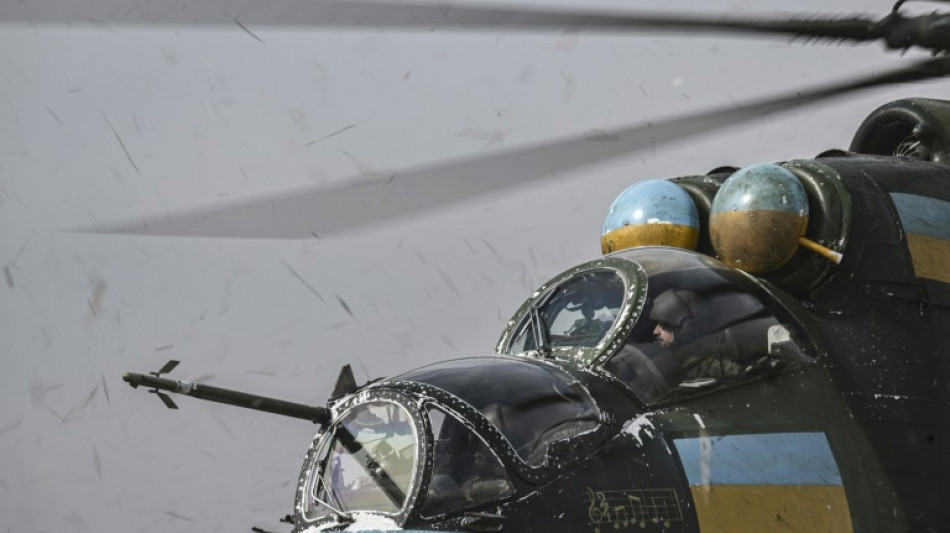
Ukraine crews conduct 'scary' missions in aged Soviet helicopters / Photo: © AFP
Anatoliy points to the few reinforced panels inside one of Ukraine's Mi-8 helicopters where he spends five-week shifts firing rockets at Russian positions.
"This is a joke, not armour," says the 39-year-old gunner, who has taken part in some 300 combat missions since last spring.
As President Volodymyr Zelensky pushes Western allies for modern weapons, pilots in eastern Ukraine admit their ancient Soviet-made helicopters are outplayed technologically by Russia.
Anatoliy's Mi-8 helicopter was built in 1986 in the USSR. Primarily a transport helicopter, it is deployed by Ukraine on battle missions despite its lack of armour.
His is decorated with a hand-drawn picture of a Cossack riding a dragon and the words: "Fight and claim victory. God will help you."
An icon hangs inside a nearby Mi-24 attack helicopter, a smaller, more manoeuvrable and heavily armoured model that flies with Mi-8s on operations.
The helicopters take off from a field, whipping up straw as their blades whirl.
Mi-24 pilot Vladyslav, who wears a large bomber jacket and woolly hat, covers his face with a scarf to speak to AFP after arriving back safely.
"It's scary because the (Russians) have invented new ways to attack us, to destroy our helicopters," he says, speaking English.
Ukrainian helicopters fly low to hide from the Russians but Moscow can attack with jet fighters from a distance of 140 kilometres (87 miles), flying at a height of over 1,000 metres (3,300 feet), he says.
- 'They only need one rocket' -
"Their reconnaissance lights us up with laser tags. That's why their rockets can hit us."
His helicopter has infra-red decoy flares that it fires to deflect heat-seeking rockets as "the only way to survive".
Nodding at his aircraft, Vladyslav says: "That helicopter is 35 years old and I can say that's a 'young' helicopter, because Mi-8 helicopters are 45 years old."
Such aged aircraft have metal fatigue problems and Ukraine cannot produce new gearboxes, engines or blades, he says. The fuselage is also vulnerable.
"They (Russians) need only one rocket to hit us and the helicopter is down."
"We need Black Hawks and Apaches. Those helicopters are very similar to our Mi-24 and Mi-8... and they have new types of missiles," he says, naming helicopters used by the US armed forces.
"If we had Apaches or Black Hawks, it would be a totally different story," agrees 28-year-old Mi-8 pilot Andriy.
"It's better to have what the US and Europe have."
The problem is not just with the helicopters but the reconnaissance systems used to detect enemy positions, the men say.
- 'Real hell' -
"The first month was real hell. We didn't know where the enemy air defences were," says Andriy.
Even now, Russia "can see half of Ukraine" Anatoliy says, while "we see (only) the most elementary things".
Vladyslav says he covers his face to protect his identity since Russians are hunting helicopter pilots.
"We're like treasure in an army," he says.
"A pilot is a very expensive product" since training one fighter pilot costs over 300 million hryvnias ($8.1 million), he explains.
"(We have lost) many comrades and many helicopters. I cannot say a number because it's a secret," he adds.
"It's a very sad situation. A lot of guys have gone who would have done good things," says Andriy.
Some Western officials have questioned the effectiveness of supplying Ukraine with the more modern combat aircraft it is requesting, since its pilots will have to retrain for a lengthy period.
"It's only half a year," says Vladyslav, pointing to the similarities between Black Hawk and Apache helicopters and the ones they fly.
"When you want to live, you learn quickly," says Anatoliy.
P.Sinclair--TNT