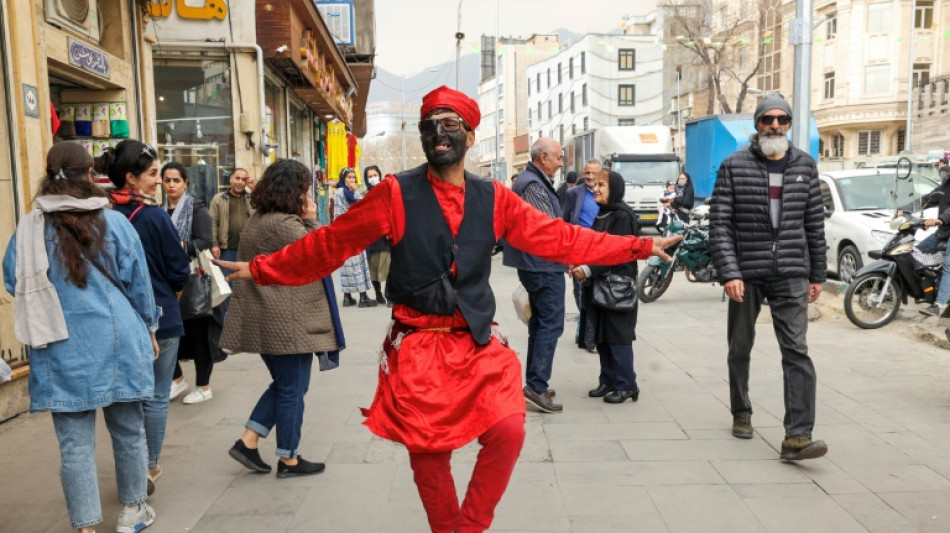
Iranians face dilemma as New Year and Ramadan coincide / Photo: © AFP
Tehran is emptying ahead of the Persian New Year, as is the case annually, but this time around Iranians are being forced to adapt as the festival coincides with Ramadan.
Over 300 million people in a dozen countries -- including Afghanistan, Iraq and Turkey -- will wish each other "Nowruz mobarak" or Happy New Year on Tuesday, when Iranians mark the entry into the year 1402 on the Persian calendar.
Celebrated for some 3,000 years, the new year festival of Nowruz begins on the first day of spring and celebrates the rebirth of nature, ushering in almost two weeks of silence on the normally bustling streets of Tehran as people abandon the city for the countryside.
"For 15 days, we try to forget the difficulties of everyday life by having a good time, eating carefully prepared meals and offering gifts to family and friends," said Laleh, a student leaving Tehran for her home city of Tabriz in the northwest.
This year however Muslims who celebrate Nowruz, including almost all of Iran's 85 million population, will have to reconcile these traditions with the obligations of Ramadan, the holy Muslim month of fasting.
During Ramadan, which is due to begin on March 22 or 23, Muslims are invited to refrain from eating and drinking from dawn to dusk.
That poses a dilemma for the closing festivities of Nowruz, 12 days after the turn of the new year marked by Sizdeh Bedar, or "the day of nature", during which Iranians go for picnics in greenery.
Last year, Attorney General Mohammad Jafar Montazeri warned those who fail to fast in public will liable to be punished.
Even eating in your car, which "is not considered a private space", is punishable, he added.
Religious expert Mohsen Alviri advises those planning to have picnics to go without food until breaking their fast.
"In Shiite jurisprudence, if the faithful travel a certain distance from their city of residence, they are considered travellers and may not fast," he said.
- 'Sad year' -
Although it is considered a pagan festival, Nowruz was never really challenged in Iran after the 1979 Islamic Revolution.
"There is no doubt that Nowruz is a national holiday that existed before Islam. But it does not contradict any of the Muslim teachings," said Mohsen Alviri, a Shiite cleric and religious historian in Tehran.
"Nowruz pays attention to the preservation of nature and emphasises eliminating resentment between people, respecting elders, visiting relatives... these are values that are strongly recommended by Islam," he added.
While waiting for Nowruz, however, some Iranians say they are not in a festive mood after a difficult year marked by high inflation and tensions on the street.
Iran has been the target of crippling US economic sanctions since 2018, the year then-president Donald Trump withdrew the United States from a landmark nuclear deal.
The Islamic republic has also been rocked by a protest movement that flared after the September 16 death in custody of Mahsa Amini, a 22-year-old Iranian Kurd who had been arrested for an alleged breach of the strict dress code for women.
The ensuing violence claimed the lives of hundreds of people, including dozens of security personnel, and saw thousands more arrested, casting a shadow over this year's new year celebrations.
"This is a very sad year. I used to love Nowruz but I'm so unhappy that I haven't even cleaned the house," said Effat, a 75-year-old woman shopping at Tehran's Tajrish bazaar.
"I haven't even bought a goldfish and a jar of wheat sprouts," she said, referring to symbolic objects used to mark the festival.
But Razieh, a housewife in her 50s, can only gaze at the stalls overflowing with colourful goods for the festival.
"I ask the prices, but without being able to buy much," she said with a sigh.
D.Kelly--TNT