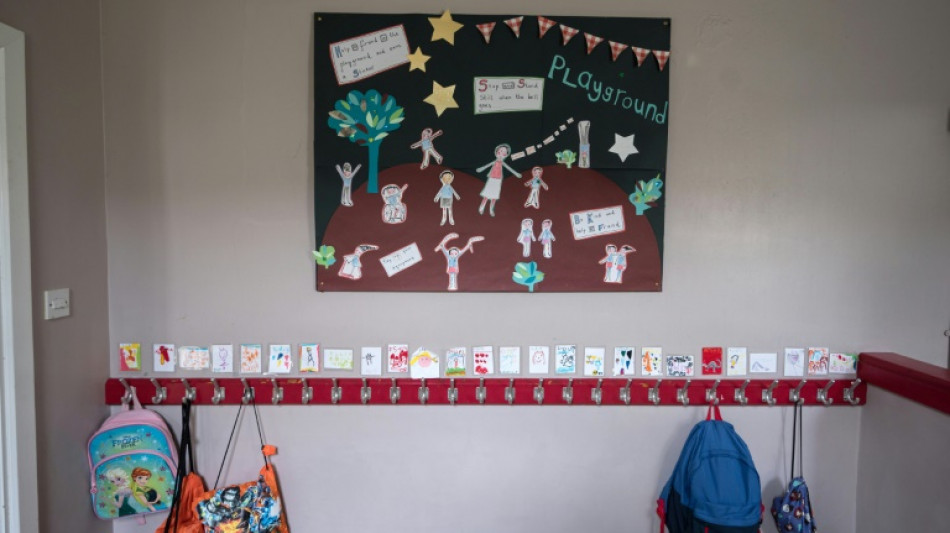
Sky-high UK childcare costs hit women's careers / Photo: © AFP
Increased childcare funding is expected to feature in the UK government's budget this week, in a bid to ease pressure on families and particularly women.
Childcare costs in the UK are among the highest in the 38-nation OECD, accounting for nearly a third (29 percent) of a family's income compared to just nine percent in France.
That has led to a situation where some parents have been forced to give up work or drastically reduce their hours -- with women often bearing the brunt -- and the UK economy suffering too.
Natalie Ford said she had "no choice" when she had her son. "I had no idea how much nurseries cost," she told AFP. "It was a bit of a shock."
She and her husband pay over £900 ($1,100) for a few days a week of childcare for their 19-month-old son -- more than what they pay for their mortgage.
Nationwide, the average nursery bill is £285 a week for a child under two, and much more in London, according to the Family and Childcare Trust charity.
Ford, 39, from Brentwood in Essex, east of London, tried to negotiate more flexible hours and working from home with her company.
But when that was refused she had no option but to quit.
She now works as an executive personal assistant from home, while her husband, an insurance broker, also does some remote work.
- 'Sacrifice' -
Very little publicly funded help exists until a child is three.
After that, the state pays for 15 hours of childcare a week, and twice that for low-income households.
But the money, paid to nurseries, often does not cover their costs, which have soared with inflation.
"My husband is a very hands-on dad," said Ford. "He does pick-ups and drop-offs (at nursery) but I feel like, even in our situation -- I'm the higher earner of the two of us -- I have to make a bit more of a sacrifice than he would, being the mum."
Actress Lucy Milnes, 40, has hardly worked since the birth of her second son two years ago but she said the situation was not sustainable.
So she and her husband decided to put him in day care three mornings a week -- the minimum accepted by the institution.
Milnes hopes this will give her "time to secure more work" and break "a vicious circle".
"We are in a position now, for the first time in decades, where women are being pushed back (from work) for a kids routine," said Joeli Brearley, from Pregnant Then Screwed, a campaign group.
"Of course there are some women who want to stay at home and that's great and they should be able to do that, but it is the lack of choice that is an issue."
- 'Impact' -
Government statistics last year showed that for the first time in at least 30 years, the number of women not working to look after their families rose by five percent.
Among 25- to 34-year-old women, the figure was 13 percent.
Of those not working, 28.5 percent said they were doing so to look after their families, compared to 6.9 percent of men.
In a recent report, consultants PWC identified the impact of childcare costs on women's employment as a major cause of the pay gap with men.
"This has enormous impact not just immediately, in term of their mental health, in term of earnings, but also it has a long-term impact," said Brearley, whose group wants reform on childcare, parental leave and flexible working
"That's why we see a lot of women living in poverty when they are older because they have lower pensions than men do."
British employers are calling for reform of the system to help ease the country's labour shortage.
When her daughter was born last year, Rachel Herr, a 39-year-old fashion designer, had to stop working on Mondays to save on childcare costs. She compensates by working from home on Saturdays.
She and her husband finally made a radical decision to move to her home country, Ireland.
Childcare costs were not the only issue: mortgage rates and the cost of living also sky-rocketed.
"When we worked it out, we realised that from October we'll start to go into debt: expenses will be more than our income, so we're forced now to sell our house and move to Ireland," said Herr.
"I feel like it's taking a step back. And I feel like it's more limiting for my career because there's less career options in Ireland for me."
A.Wood--TNT