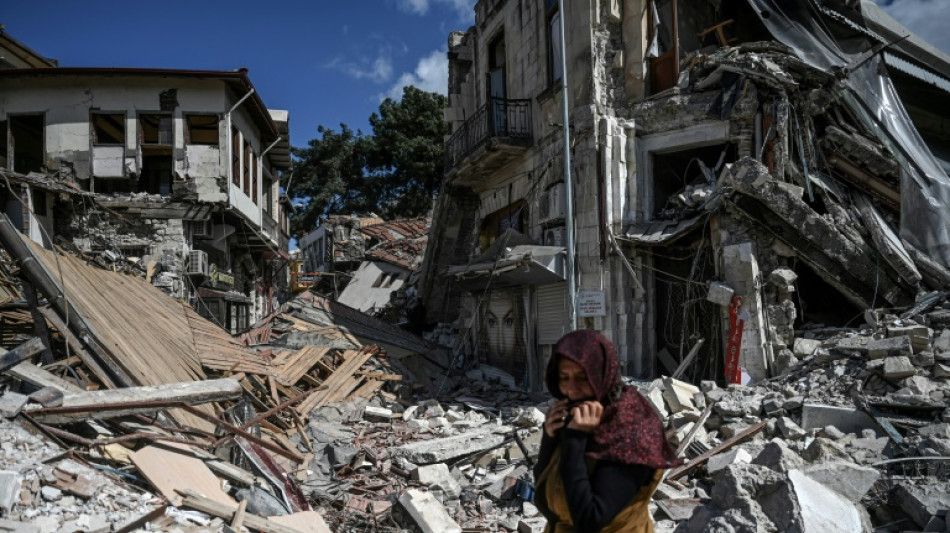
Women deal with added burdens of Turkey's quake disaster / Photo: © AFP
The shelves of the makeshift clinic -- little more than an orange storage container -- offer everything women are too shy to ask for on the streets of Turkey's quake zone.
From underwear to period and contraception products, doctor Meltem Gunbegi reconnects women with the basics they feel uncomfortable discussing in the crowds of mass aid distribution centres.
She also offers a receptive ear, helping the women of southern Turkey's destroyed city of Antakya to start processing the grief and death they have been subjected to in the past month.
The toll from the 7.8-magnitude earthquake now stands at more than 46,000 in Turkey and at nearly 6,000 in Syria, making it one of the world's 10 deadliest of the past 100 years.
A top United Nations official said on Tuesday that the damage alone amounted to more than $100 billion, with extra money needed for recovery costs.
"Many are shy when it comes to asking for basics, such as bras, wax bands and tweezers, so they come and visit our container," said the 33-year-old doctor.
More women are having genital issues because of poor hygiene conditions in the tent cities set up across the 11 quake-hit provinces, Gunbegi said.
But she also sees women who are clearly still in shock and too traumatised to start thinking about their own bodies -- even when they are pregnant.
"They experienced a lot of death, a lot of destruction," said the doctor. "They really don't seem to think about the baby. They are in a state of trauma."
- 'Insecure' -
Selver Buyukkeles, an earthquake survivor who works with the Mor Cati (Purple Roof) shelter foundation, said women bore the brunt of daily burdens -- such as doing chores and taking care of family -- even before the February 6 quake.
Now, they are trying to do the same while dealing with personal pain and an acute sense of insecurity that comes with life out on the streets.
"Women queue to get food at distribution centres. They cook, they take care of the children and the elderly. They do the dishes. They do the laundry," the 28-year-old said.
"Women feel responsible for their family's situation. They fear a new earthquake and the communal life in tents makes them insecure," she said.
At this stage, activists and doctors interviewed by AFP have not observed more cases of domestic violence or abuse, despite Turkey's poor record on the issue.
Fidan Ataselim, secretary general of the We Will Stop Femicide Platform, has called for "safe shelters" and "prevention centres" to be set up for women in damaged regions.
We Will Stop Femicide publicises the murder and abuse of women in the mostly Muslim but officially secular state.
In 2022, at least 327 women were killed and 793 injured, according to data compiled by the platform.
- 'Safe zone' -
Back at Antakya's Dostluk (Friendship) park, not far from Gunbegi's makeshift clinic, volunteers work in shifts making sure that some 200 women sheltering in dozens of tents are safe.
Others are keeping vigil outside toilets and shower cabins.
"Safe zone for women and LGBT+ here," proclaim posters in Turkish and Arabic.
The Arabic is a nod to the millions of refugees and migrants who have been living across stretches of southern Turkey since the start of the civil war in neighbouring Syria 12 years ago.
"We have a security system for both women and LGBT+, who are more vulnerable in such disasters," said Aslihan Keles, 23, one of the volunteers in the park.
Turkish women often join marches on March 8 -- the official International Women's Day -- demanding better lives and protection against domestic violence.
But this year, things are different in the quake zone, Keles said.
"Here, there is an emergency," she said. "This time, we are in field -- but for a very good cause."
F.Jackson--TNT