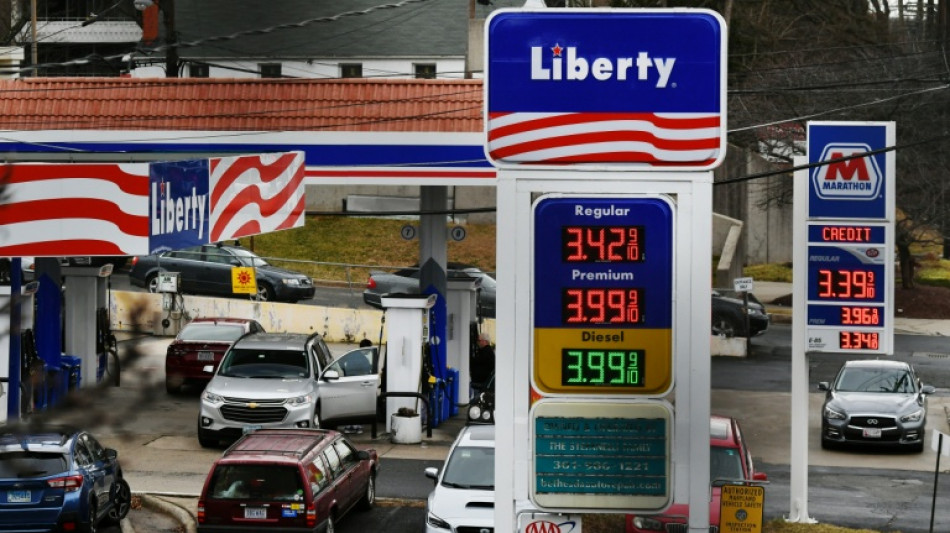
Americans ponder the cost of 'defending freedom' in Ukraine
President Joe Biden has told Americans to prepare for the "costs" of Washington's pushback against Russian aggression in Ukraine, but truck driver Jeremy Rakestraw wonders if he hasn't paid enough already.
He decided to sell his truck when its monthly fuel bill more than doubled to $17,000, and though he's back on the road towing cargo in the vehicle of a company that covers his gas, the high inflation Americans have faced over the past year continues to eat into his pay.
"Nobody is home using my electricity and gas, and it's still going up," Rakestraw said as he sat in his idling 18-wheeler at a truck stop in Jessup, Maryland, 31 hours from his Salt Lake City home and two-and-a-half hours from the New Jersey town where cargo was waiting for him to pick up.
As for Biden, "I don't think he's doing nearly enough," Rakestraw said.
Such is the dilemma the US president faced as he prepared to announce new sanctions against Moscow on Thursday, after warning a nation weary from months of massive leaps in consumer prices that "defending freedom will have costs for us as well."
The tensions with Moscow have already played a large part in pushing up fuel prices. Yet some who make their living roaming America's roads also recognize the need for Washington to take action to stop or at least limit a bloody war -- even if it could push gas prices up even higher.
"For every action there is equal and opposite reaction. They have to do something," said Abdullahi Ali, a taxi driver waiting for a fare outside Union Station in Washington, where passenger traffic is far more scarce than before the pandemic.
He spoke early Wednesday, hours before Russia launched a full-scale invasion of Ukraine.
- 'Risk premium' -
For months, rising costs for everything from fuel to food have worn Americans down, making them feel less content with Biden's leadership and unenthusiastic about the economy even as wages rise and millions of people who lost their jobs when Covid-19 broke out return to work.
The University of Michigan index tracking consumer sentiment plunged this month to its lowest level in 10 years while the average gallon of gas currently goes for $3.53, about a dollar more than before the pandemic, according to the American Automobile Association.
"Americans are already paying a little bit of a risk premium, if you will, simply because the temperature has risen" with Russia, said Patrick De Haan, head of petroleum analysis at GasBuddy.
Yet the United States is also a major oil producer, and Keith Wood, a truck driver waiting to set out from Jessup, wondered why events far beyond its borders would bleed into what he pays at the pump.
"We're supposed to be self-sufficient so I don't know why the price would go up," he said.
- Energy independence -
Oil is traded on a global market, meaning even though the United States is a major exporter of crude, that doesn't necessarily offer drivers relief when prices spike.
And spike they did on Thursday. After Putin overnight ordered a major Russian military operation against Ukraine, European and US benchmark crudes breached the $100-per-barrel mark for the first time since 2014.
While Biden has promised to take steps to offset price increases, De Haan said, "No president can upend change in the global market."
Moscow understands that well, and De Haan predicted it will use the threat of cutting off access to its own ample production of oil to try to get Western countries to back off when it comes to Ukraine.
"It would shoot themselves in the foot if they limit oil exports but even the talk of it could inspire some kind of breakthrough that goes in Russia's favor," he said.
The prices of gas and diesel are among the most prominent indicators of the cost of living in the world's largest economy, and voters have been known to take out their frustration over high costs on presidents and their political parties.
Dipson Abass' earnings as a taxi driver in Washington have already suffered as prices rose. Yet as he pondered the situation in Ukraine, he expressed a willingness to bear whatever consequences the sanctions bring.
"Price of gas is nothing compared with human life," he said. "So I will just say whatever sanction they can pass onto Russia, let it go."
T.Hancock--TNT