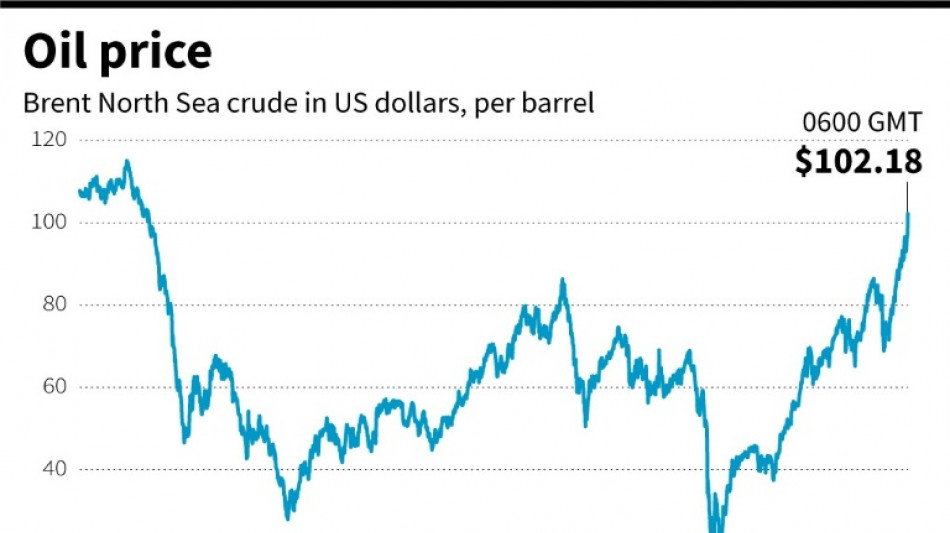
A history of $100 crude oil
World oil prices on Thursday breached $100 for the first time in more than seven years, this time on supply fears after major producer Russia attacked Ukraine.
European benchmark Brent North Sea crude surged more than eight percent to $105.79 per barrel -- the highest level since 2014.
US contract West Texas Intermediate reached $100.54 per barrel, also a peak last seen more than seven years ago.
That capped a meteoric rise over almost two years since crude fell into negative territory for the first time.
In early 2020, oil briefly turned negative following the onset of the coronavirus pandemic that shut offices and factories -- and grounded planes worldwide.
The market tumbled also on scarce storage facilities and a Saudi-Russia price war.
WTI slumped to minus $40.32, meaning that producers paid buyers to take the oil off their hands.
At the same time, Brent tanked to a record low $15.98.
Oil prices have since recovered, rocketing last year to around $70 per barrel as economies reopened from lockdowns, sparking a surge in demand for crude.
Russia is a key member of the expanded OPEC+ producers' grouping that also includes number one player Saudi Arabia.
Here is a timeline of when oil previously topped $100.
- 2012: Iran crude embargo -
Oil started the year above $100 after Western powers imposed a raft of economic sanctions on Iran, including crude exports, aimed at halting its controversial nuclear programme.
- 2011: Arab Spring -
Brent soared to $127 in March 2011 following unrest in the oil-producing Middle East and North Africa region.
The market bounded higher after the so-called Arab Spring uprisings toppled the long-standing leaders of Tunisia, Egypt and Yemen, while unrest also rocked other parts of the region, especially crude producer Libya.
- 2008: Record-high $147 -
On July 11, 2008, Brent hit a record high of $147.50 per barrel, having breached $100 at the start of the year for the first time.
The same day, WTI achieved an all-time peak at $147.27 per barrel.
Crude surged thanks to falling stockpiles in the United States, strong Chinese demand and unrest in key OPEC members Iran and Nigeria.
A weaker dollar also lent strong support, making crude, priced in the currency, cheaper for buyers holding other currencies.
But by December 2008, Brent had tanked to sit at around $36 owing to a severe economic recession worldwide in the wake of the global financial crisis.
burs-em-bcp/rfj/rl
L.Graham--TNT