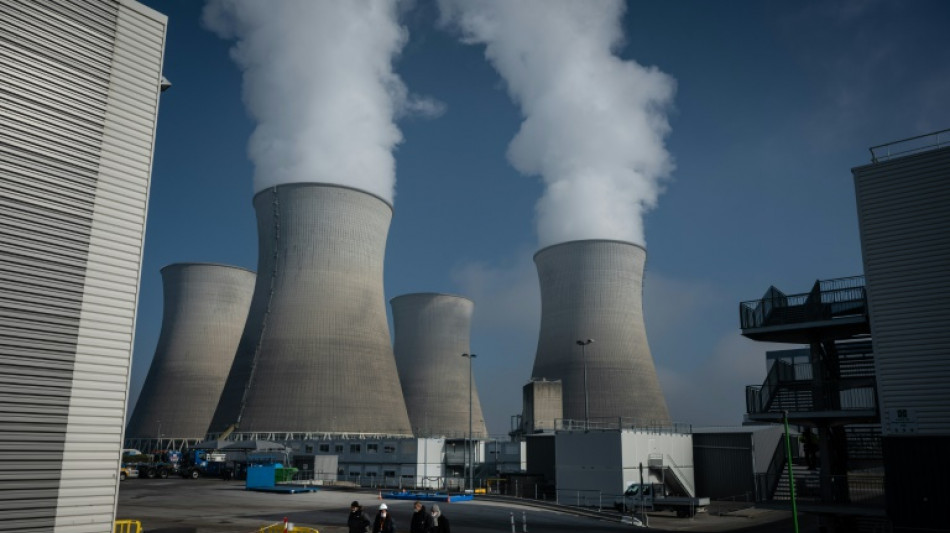
Ukraine fallout pushes French nuclear giant EDF into historic loss / Photo: © AFP/File
EDF reported one of the biggest losses in French corporate history Friday, as fallout from the Ukraine war and idling nuclear reactors spelt financial disaster for the state-controlled energy giant.
Earnings and debt both worsened dramatically in 2022 as EDF struggled with a drop in electricity output after shutting down a big chunk of France's nuclear plants to fix corrosion problems, and a heatwave reduced hydro-power production.
After Russia's invasion of Ukraine sent energy prices soaring, the government ordered EDF to sell energy at below cost to consumers -- forcing it deeper into the red.
"The 2022 results were significantly affected by the decline in our electricity output, and also by exceptional regulatory measures introduced in France in difficult market conditions," chief executive Luc Remont said in a statement.
EDF's debt ballooned to 64.5 billion euros ($68.6 billion) in 2022 while losses totalled 17.9 billion euros, after a profit of over five billion euros in 2021.
In the past two decades, only former entertainment behemoth Vivendi Universal and communications giant France Telecom have reported bigger annual losses in France.
A bright spot was EDF's revenue, which rose by 70 percent to 143.5 billion euros last year due to the spiking energy prices.
Remont became EDF's boss in November of last year, tasked with carrying out President Emmanuel Macron's plans to make France less dependent on Russian gas, and fossil fuels in general, by investing in a new generation of nuclear energy reactors and renewables.
- 'Mission of a lifetime' -
The government on Friday quickly reminded the EDF boss of his main job.
"EDF's financial recovery will most of all require an increase in production," Finance Minister Bruno Le Maire and Ecological Transition Minister Agnes Pannier-Runacher said in a joint statement within minutes of the results statement.
Expressing their "full confidence" in the new CEO, they called on him to "prepare the project of new EPRs decided by the president".
Macron said in February of last year that he wants a nuclear "renaissance" that would see up to 14 new reactors in France of the new-generation EPR type.
Remont, a top civil servant with private banking experience, replaced Jean-Bernard Levy, whose departure was seen a foregone conclusion when the government announced in July that it would take full ownership of the debt-laden firm to ensure the country's energy security.
Ahead of his appointment, Remont said: "This could be the mission of a lifetime".
His job to boost energy production has become harder because of ongoing countrywide protests and strikes against Macron's plans for pension reform that are being followed by much of EDF's highly-unionised staff.
In a single night this week, striking workers caused a drop of 3,000 megawatts of electricity output, the equivalent of production at three nuclear reactors.
"We're ready to shut France down," hard-left energy union leader Fabrice Coudour told AFP ahead of a major protest day scheduled for March 7.
At the end of last year, EDF had to announce another six-month delay for its next-generation reactor at Flamanville, the latest setback for the flagship technology the country hopes to sell worldwide.
Similar projects at Olkiluoto in Finland, Hinkley Point in Britain and the Taishan plant in China have also suffered production setbacks, cost overruns and delays.
France's 56 ageing reactors normally provide some 70 percent of France's electricity needs, but a dozen are offline for maintenance.
Meanwhile French MPs have moved ahead with a law to accelerate the deployment of renewable energy, after Macron secured rare support from the left for lowering hurdles to building new solar and wind plants -- including massive offshore wind farms.
Macron has set a target of building 50 offshore plants by 2050, up from one today, and of multiplying solar capacity by 10.
burs-jh/tgb/lth
L.A.Adams--TNT