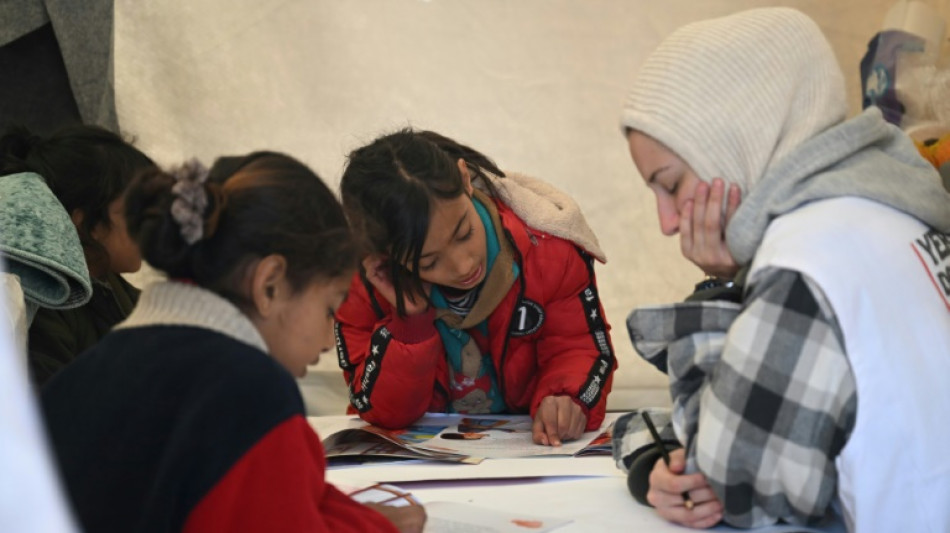
'Are we going to die?': Trauma haunts Turkish kids after quake / Photo: © AFP
Serkan Tatoglu is haunted by the question his six-year-old keeps asking since their house collapsed in last week's earthquake in Turkey.
"Are we going to die?" she wonders, while looking up at scenes reminiscent of an apocalyptic movie set.
Coffins line roadsides, and ambulance sirens wail around the clock.
Walking through the rubble of flattened buildings, children watch as rescue workers lift body bags from the putrid-smelling debris.
Tatoglu helped his four children -- aged between six and 15 -- escape their house after the first 7.8-magnitude tremor rattled southeastern Turkey and parts of Syria before dawn on February 6.
Their building crumbled in one of the nearly 3,000 aftershocks. More than 35,000 have died across the region and the toll is likely to keep climbing for days.
Tatoglu lost nearly a dozen relatives.
But the 41-year-old knows he has to stand strong in the face of his unbearable heartache.
Tatoglu's first job is to shield his children from the horrors that keep popping into their heads as they wait out the aftershocks in a tent city near the quake's epicentre in southern Kahramanmaras.
"The youngest, traumatised by the aftershocks, keeps asking: 'Dad, are we going to die?'" Tatoglu said.
"She keeps asking about our relatives. I don't show them their dead bodies. My wife and I hug them and say 'everything is alright'."
- 'I can't do anything' -
Psychologist Sueda Deveci of the Doctors Worldwide Turkey volunteer organisation said adults need as much emotional support as children in the aftermath of such a tragedy.
She said older generations were quicker to internalise the profound scale of how much their lives have changed -- and just how much they have lost.
"One mother told me: 'Everyone tells me to be strong, but I can't do anything. I can't take care of my kids, I can't eat'," Deveci said while working in the tent city.
Deveci is gaining better insight into what the children are feeling from what they draw as they while away the time in the cold.
"I don't talk to them about the earthquake much. We are drawing. We will see how much of it is reflected in their drawings," she said.
For now, their art is mostly normal.
Child rights expert Esin Koman said this was because children adapt to their surroundings more quickly than adults.
But she added that the quake's destruction of existing social support networks left them dangerously exposed to long-term trauma.
"Some children have lost their families. There is nobody now to provide them with mental support," Koman said.
-'Where's my mum?'-
Psychologist Cihan Celik posted one exchange on Twitter he had with a paramedic involved in rescue work.
The paramedic told Celik that kids pulled from the rubble almost immediately asked about their missing parents.
"The wounded children ask: 'Where's my mum, where's my dad? Are you kidnapping me?'," the paramedic recalled.
Turkey's vice president Fuat Oktay said 574 children pulled from collapsed buildings were found without any surviving parents.
Only 76 had been returned to other family members.
One voluntary psychologist working in a children's support centre in Hatay province -- where the level of destruction was some of the worst in Turkey -- said numerous parents were frantically looking for missing kids.
"We receive a barrage of calls about missing children," Hatice Goz said by phone from Hatay province.
"But if the child still cannot speak, the family is unable to find them."
- Happy thoughts -
Selma Karaaslan is trying her hardest to keep her two grandchildren safe.
The 52-year-old has been living with them in a car parked along one of the debris-strewn roads of Kahramanmaras ever since the quake struck.
Karaaslan tries to talk to them about anything but the quake. She figures that they are much less likely to have haunting memories of the disaster if she fills their heads with happy thoughts.
But the questions still come.
"Grandma, will there be another earthquake?" the six-year-old demanded at one point.
S.O'brien--TNT