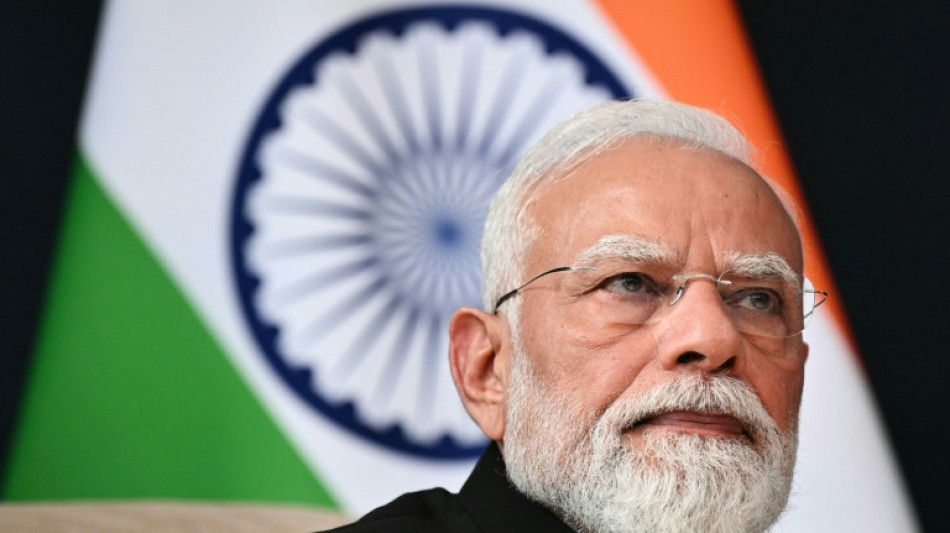
India's youth protests puncture Modi's aura of invincibility / Photo: © AFP
Indian Prime Minister Narendra Modi's carefully built image of invincibility is facing its toughest test yet, analysts say, after his government backed down in the face of youth-led protests over exam irregularities and jobs prospects.
The government's retreat marks a rare reversal for a leader whose brand has for more than a decade projected strength and an unwillingness to back down.
Demonstrations led by the online Cockroach Janta Party (CJP) movement last week spread from New Delhi to cities nationwide, forcing the resignation of education minister Dharmendra Pradhan.
The government also agreed not to prosecute protesters detained during the unrest, among other concessions.
Analysts say the climbdown, ahead of key state elections next year, is one of the few occasions public pressure has compelled Modi, 75, to backtrack since he took power in 2014.
"The resignation is definitely a surprise, because it is not in Mr. Modi's temperament to take a back step," analyst Nilanjan Mukhopadhyay, who has written Modi's biography, told AFP.
Mukhopadhyay called the reversal the "biggest possible hit" to "brand Modi" since he rose to prominence as Gujarat's chief minister in 2001.
"Twenty-five years of brand building, a lot of it has been very heavily damaged," he said.
"I am not very sure whether he will be able to recover (from) it immediately."
- Breaking barriers -
The government initially appeared confident it could contain the protests.
But a police crackdown on crowds marching towards parliament on July 20 backfired, galvanising support for the movement and transforming anger over exam leaks into a broader expression of youth frustration.
Opposition parties and sections of civil society rallied behind the protesters, while images of police action circulated widely online.
As momentum grew, the political cost of holding firm appeared to outweigh the risks.
"These young people have shown that if you stand up, you are likely to succeed," he told AFP. "They've broken through that barrier of fear."
The protests have also dented the perception that Modi and his ruling right-wing Bharatiya Janata Party (BJP) were invincible, Bose said.
Despite the setbacks, Modi dominates national politics, and his government has sought to get ahead of the crisis, pledging legal reforms and swift punishment for those involved in exam paper leaks.
The unrest comes at a sensitive moment for the BJP, which is preparing for electoral battles in Punjab, Gujarat and Uttar Pradesh.
For India's fragmented opposition, the protests have offered a rare opportunity to pressure the government.
But Bose said whether the opposition can convert youth anger into electoral gains would depend on its ability to present a united challenge to the BJP.
- Memes, reels -
Modi suffered a setback online as well as on the streets, analysts say, as the protests exposed a rapidly changing digital landscape in which the BJP no longer enjoys the dominance it once wielded.
"The government focused on maximising network strength, but it did not pay attention to the way that the algorithms changed," said Joyojeet Pal, a professor at the University of Michigan.
As of Wednesday, the BJP's Instagram account has 9.6 million followers while the CJP, launched only in May, has more than 26 million.
Rather than controlling the narrative, the party found itself confronting a wave of reels and memes on Instagram and X.
The trend underscores how dissent is increasingly being shaped by internet culture, particularly among the Gen Z.
In an apparent attempt to connect with that audience, Modi released two vertically shot, selfie-style videos, vowing stronger action against those involved in paper leaks.
The format marked a departure from his tightly scripted recordings. But the videos themselves became a subject of further mockery online.
Pal said the episode highlighted how digital spaces have become one of the few arenas where criticism of the government can quickly gain traction.
"Social media has now permeated to the smallest towns in India, and has near ubiquity among young Indians," he told AFP.
"When the spaces to criticise the government become less and less, any space that opens up becomes a key space for dissent."
F.Adams--TNT