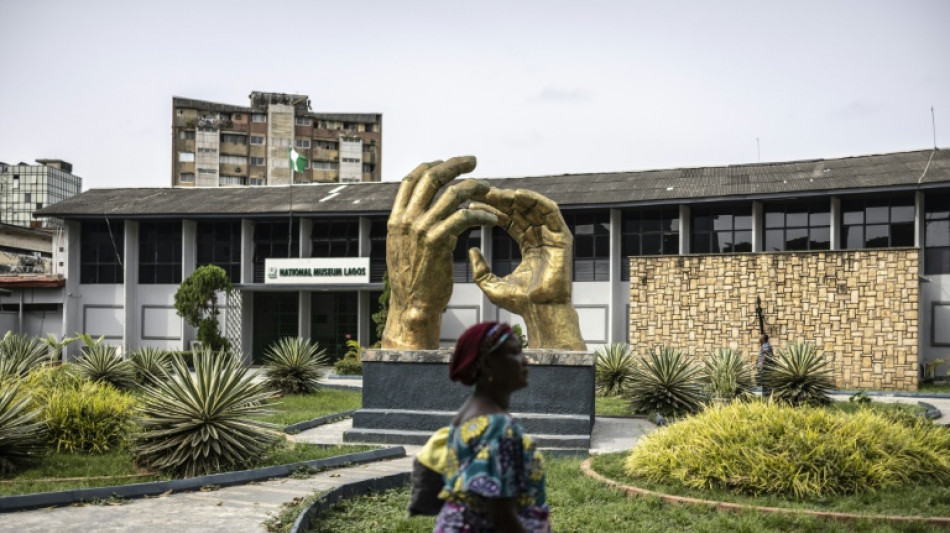
Switzerland returns famed Benin Bronzes to Nigeria / Photo: © AFP
Swiss authorities on Monday returned 18 Benin Bronzes to Nigeria in a ceremony at the National Museum in Lagos, the latest addition to the nation's growing collection of repatriated treasures.
Countries across Africa have been pushing in recent years for the restitution of artefacts and artworks taken during the colonial period -- including Nigeria's famed Benin Bronzes, which were looted as spoils of war by the British and today are scattered in museums and private collections across the world.
Hundreds of the priceless sculptures and plaques were taken from the royal palace in the Kingdom of Benin, in what is now part of modern-day Nigeria, after British forces attacked Benin City in 1897.
Monday's restitution represents the return of "evidence of civilisation that already mastered bronze casting to a standard of technical, artistic and extremely intricate sophistication" before colonisation, Nigeria's culture minister, Hannatu Musa Musawa, said at the ceremony.
The handover also included a bronze bracelet and four Ikom monoliths from the Niger Delta region, "seized in Switzerland as part of criminal proceedings and subsequently transferred to the state", Switzerland's federal department of home affairs said in a statement.
The bronzes came from the Ethnographic Museum at the University of Zurich, the Museum Rietberg and the Musee d'Ethnographie de Geneve.
"The artefacts returned today carry a painful history," Elisabeth Baume-Schneider, a Swiss federal councillor, said at the ceremony.
"Many of them left the Kingdom of Benin, their place of origin, as a result of violence, looting and deeply unequal power relations."
Western museums, including those in Britain, the Netherlands and Germany, have returned several hundred African artefacts in recent years, but hundreds more are believed to still be missing.
Other times, their locations are known, but museums and governments refuse to return them.
Restitution has also run into homegrown roadblocks: Nigerian government authorities and Benin's traditional rulers have at times been at loggerheads over who should have possession of the bronzes.
Protests delayed the opening of the Museum of West African Art in Benin City last year, which was set to display a collection of bronzes.
But Alice Hertzog, director of the Ethnographic Museum at the University of Zurich, said the bronzes "never should have been in Switzerland in the first place".
"They have graced our exhibition halls, they featured on our posters and in our publications," Hertzog said.
"We have cared for them. We have preserved them, but they were never ours to keep."
Musawa said Switzerland's move should be emulated by "every single nation holding African heritage".
S.Mitchell--TNT