Boycott over Israel takes some glitz off Eurovision final / Photo: © APA/AFP
A fiery Finnish violinist-singer duo and an acclaimed Australian star are the favourites to win Saturday's grand final of the Eurovision Song Contest, as protesters demonstrated in host city Vienna against Israel's participation.
This year marks the 70th edition of the world's biggest televised music event, which despite the razzmatazz rarely escapes the politics in the background.
Five countries, including Spain -- one of Eurovision's biggest financial contributors -- are staying away in protest over Israel's war in Gaza.
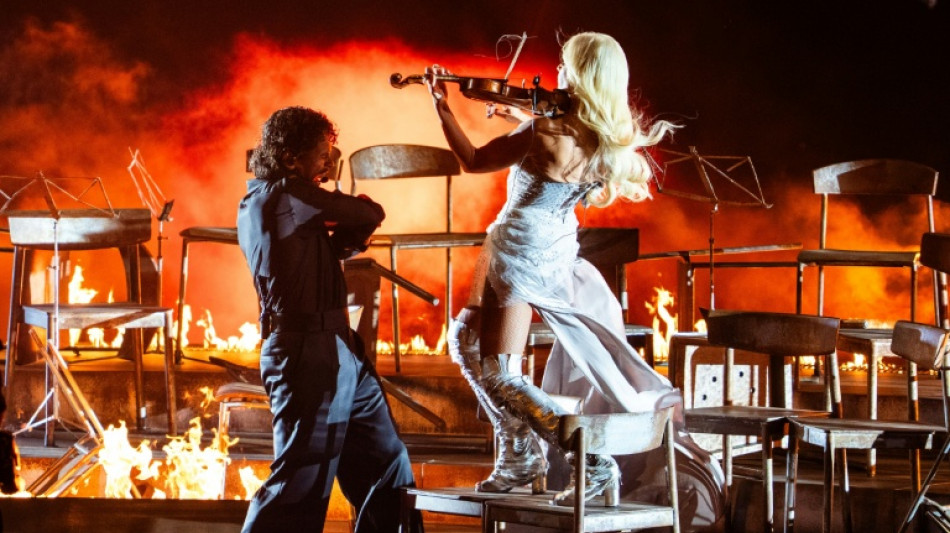
The overwhelming favourites in the 25-country final were the Finnish act of violinist Linda Lampenius and pop singer Pete Parkkonen, who set ablaze the immense circular stage of Vienna's Stadthalle venue in the first semi-final on Tuesday.
Australia's Delta Goodrem, who has sold nine million albums, was also coming in hot, according to the latest media poll, which puts her in first place after a semi-final performance that had her soar into the air atop a glittering piano.
The final begins at 1900 GMT with more than 10,000 Eurovision fans in party mood set to pack out Austria's biggest arena.
"It's going to come down to Finland and Australia," Fabien Randanne, a journalist at French news outlet 20 Minutes and a specialist on the contest, told AFP.
- 'Star aura' -
Lampenius, 56, got special permission to use her Gagliano violin -- made in 1781 -- live. Given the complexities of staging the mammoth show, usually only the vocals are performed live at Eurovision.
The 41-year-old Goodrem, who had a string of international hits in the early 2000s, has raised hopes of a first win for her country with "Eclipse", a song evoking a romantic alignment of the planets.
Australia has appeared at Eurovision by invitation since 2015.
"The European public still has more or less conscious reservations about voting for Australia... but perhaps Delta Goodrem's star aura can spur them to rally around her," Randanne said.
Her rise has come at the expense of Greece, Israel, Denmark and France, all of which slipped in the rankings of bookmakers.
Romania's Alexandra Capitanescu, 22, was an outside bet thanks to an electrifying stage presence with her metal track "Choke Me".
Meanwhile, Sal Da Vinci, 57, could emerge as "the dark horse" with his love song "Per sempre si" ("Forever yes"), according to Sebastien Dias-das-Almas, a French journalist who has covered Eurovision since 2011.
A major figure on the Italian music scene, Da Vinci "could appeal to the traditional audience, who only follow the contest on television on the night", Dias-das-Almas said.
- Multi-lingual show -
While stage designs vary in boldness, songs range from pop to heavy rock and electro.
"Everyone's bringing their A-game. The show is going to absolutely astounding and vintage Eurovision. I saw some of the rehearsals and my jaw was on the floor," said Eurovision director Martin Green.
Across Eurovision week, though 16 songs were in English, words from 25 languages and dialects were sung on stage, including Neapolitan, Japanese and Maltese.
"I feel like we are the underdog in this year's competition," Malta's entrant Aidan, who is singing a classic romantic ballad, "Bella".
"As a huge Eurovision fan myself I've seen the need for true music, real music at Eurovision. I feel like 'Bella' does that, and it's very rich music," he told AFP.
- Parties and protests -
Undeterred by rain in Vienna, many have taken musical cruises on the Danube and sang karaoke in the huge fan zone set up in front of the City Hall and aboard trams crisscrossing the city.
Some 166 million viewers watched the contest on television last year when it was hosted in Basel, Switzerland.
Austria hopes to match that figure despite the boycott by Iceland, Ireland, the Netherlands, Slovenia and Spain, and a call by more than 1,000 artists not to watch Eurovision over Israel's participation.
Spanish Prime Minister Pedro Sanchez on Friday said he was certain his country was on "the right side of history" by snubbing the event because of Israel's "genocide".
Hundreds of demonstrators shouted "Free, free Palestine" in a central Vienna square hours before the final, under heavy police presence.
They held banners reading "Block Eurovision. Don't celebrate genocide".
"It's very weak of Austria that it isn't taking a boycotting stance itself," 17-year-old student Juli Pfefferkorn told AFP.
G.Waters--TNT