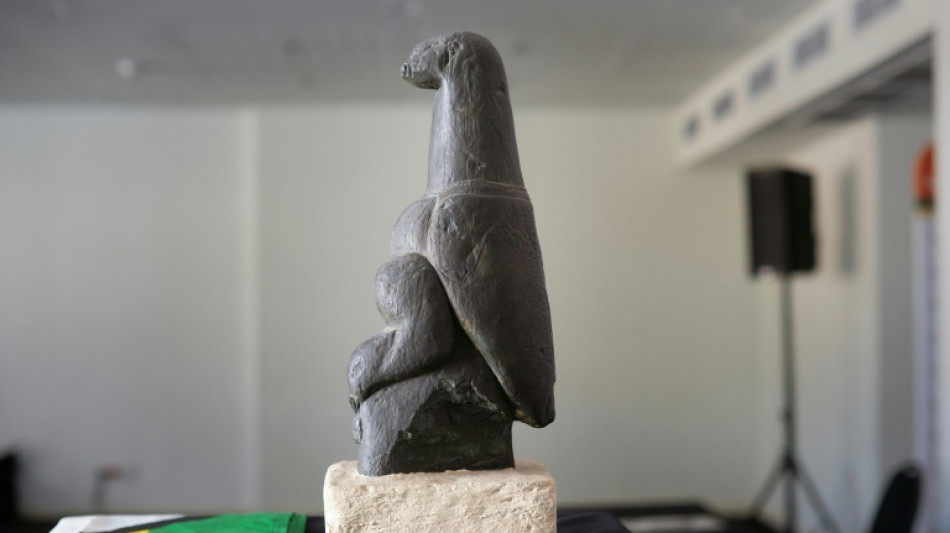
S.Africa returns stolen human remains, sacred carving to Zimbabwe / Photo: © AFP
South Africa on Tuesday handed back to Zimbabwe ancestral human remains and a centuries-old stone carving of its sacred national emblem, the Zimbabwe bird, stolen more than 100 years ago during the colonial era.
The restitution was part of a worldwide push for the repatriation of artefacts looted from African countries during colonisation.
Eight coffins draped in the Zimbabwean flag stood at an event for the handover in a Cape Town museum which was attended by officials from both countries.
Little was known about the remains except that they were of people who had been exhumed as "scientific specimens", officials said.
One was believed to have been a tribal chief whose skull and jaw were collected in 1910, culture minister Gayton McKenzie said.
"He was somebody's leader, a lot of people's ancestor. He has been sitting in the museum drawer for 116 years," McKenzie said.
Another was believed to be a man murdered over accusations of witchcraft.
"They were removed from their graves -- not found, not donated," McKenzie said.
Once repatriated, the remains would be returned to "where they belong", Zimbabwean government representative, Reverend Paul Damasane, said.
- Identity and spirit -
The soapstone carving of a Zimbabwe bird that was returned at the event was the first of several looted from the stone ruins of the ancient complex of Great Zimbabwe built in the 11th to 13th centuries, officials said.
A British explorer had ripped it from its pedestal in the late 19th century and sold it to British mining magnate Cecil John Rhodes, the 1890-1896 prime minister of the Cape Colony.
It was displayed at Rhodes's Cape Town estate which was bequeathed to the government on his death in 1902.
Nearly "140 years since the first one was taken and sold to Cecil John Rhodes, that very same statue ... is finally making its journey home," South Africa's culture ministry said.
South Africa had returned four other ancient carvings of the birds the year following the former British colony's independence in 1980, officials said.
The original grey-green birds are around 33 centimetres (13 inches) in height and most were perched on stone columns more than a metre high at Great Zimbabwe, the centre of a once-powerful civilisation.
They are the national emblem of Zimbabwe, depicted on banknotes, coins and the national flag, and considered.
Great Zimbabwe, a UNESCO World Heritage Site situated in the southeast of the country, is undergoing a $5-million revamp funded by the French development agency that is due for completion in the coming weeks.
The complex is Africa's second-largest remaining pre-colonial structure after the pyramids of Egypt.
T.Bailey--TNT