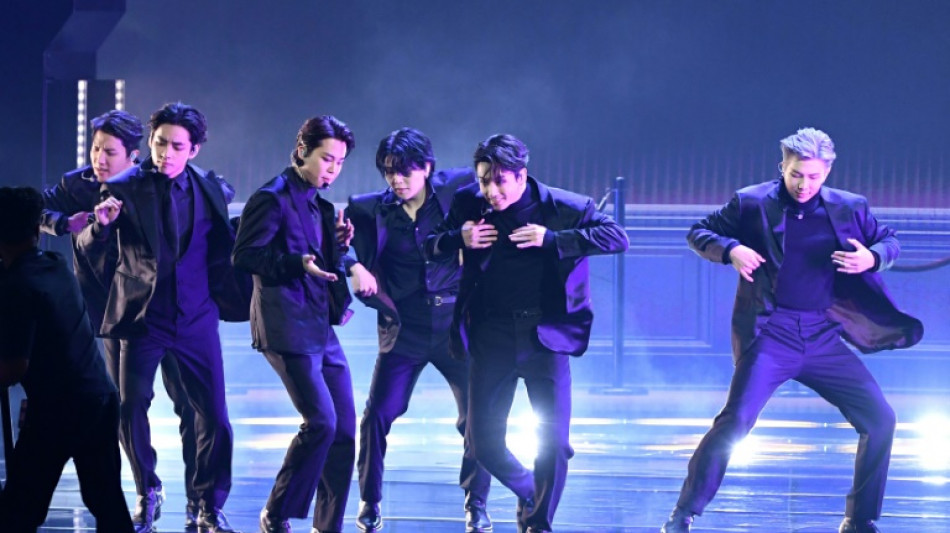
K-pop legends and kings of 'soft power': South Korea's BTS / Photo: © AFP/File
Popstars, diplomats, activists: South Korean megastars BTS are like modern day Renaissance men, dominating the charts even as they represent their country and campaign for causes close to their heart, analysts say.
The trailblazing boy band, who announced they would go on a break Tuesday, are credited with transforming the global music industry -- the first all-Korean group to dominate the US and UK charts and build a truly global fanbase.
They've spoken at the United Nations and appeared at the White House to fight racism, while still remaining one of the most popular bands in the world on TikTok, Instagram and Twitter.
There is "no one with greater global cultural power or soft power than BTS," Linda Hasunuma, a political scientist at Temple University, told AFP.
"They have more power to influence culture than any politician or celebrity," she said, pointing to their record-breaking social following.
But at the height of their powers, the band said Tuesday that they were "exhausted" and would take a break, telling their fans that they needed time apart.
"The problem with K-pop and the whole idol system is that they don't give you time to mature," member RM, 27, said, referring to South Korea's notoriously hard-driving music business model.
- Relentless industry -
Like almost all K-pop groups, BTS -- or Bangtan Sonyeondan, which translates as Bulletproof Boy Scouts -- were formed by an entertainment agency.
Big Hit Entertainment assembled J-Hope, Jimin, Jin, Jungkook, RM, Suga and V through a combination of direct recruitment and auditions.
Local reports say the group -- who are known to be relentlessly hardworking -- went through intensive training ahead of their debut in 2013.
Leader RM was already known in the South's underground hip hop scene for his rapping skills, while Jimin had been enrolled in an arts school in Busan, majoring in contemporary dance.
The group have since ascended to global superstardom, having been twice nominated for a Grammy and staging a string of sold-out shows in cities including London, Paris and Los Angeles.
Their lyrics are socially conscious and they consistently and candidly engage with fans at home and abroad through social media, accumulating some 86 million followers on Twitter alone.
The band has become "an icon of progressive globalism," said Vladimir Tikhonov, professor of Korean Studies at the University of Oslo.
"They are part of the entrepreneurial world, being managed by a for-profit agency and earning astronomic sums... But at the same time, they and their fans supported anti-racist movements," he said.
In 2020 they donated $1 million to the Black Lives Matter movement, inspiring fans to contribute the same amount.
And they spoke in Korean at the White House on May 31 seeking to raise awareness of anti-Asian racism in America -- a phenomenon many blame on fallout from the Covid-19 pandemic.
Member Suga appealed for tolerance, saying that "it's not wrong to be different. I think equality begins when we open up and embrace all of our differences."
The group "has already exceeded the level of a famous pop star in some ways," Jiyoung Lee, a research professor at Hankuk University of Foreign Studies in Seoul, told AFP.
"The symbolic meaning of them is believed to embody to some extent the zeitgeist of the present era."
- Cut-throat competition -
Beneath its glitz and glamour, South Korea's K-pop industry is known for cut-throat competition and relentless public pressure to maintain a wholesome image at all times and at any cost.
In Tuesday's YouTube video the members of BTS, credited with generating billions of dollars for the South Korean economy, candidly shared their struggles within the industry.
"I don't have time to grow because I have to keep filming and keep doing something," RM said, referring to the team's busy work schedule.
Although the group are currently at the "very peak" of their success, RM said he "didn't know what kind of group we were any more."
Member Suga confessed he's not had much fun writing lyrics since their debut in 2013.
"It was always painful, always hard, and I had to squeeze something out," he said.
Local media say the band could be on hiatus for up to seven years, given the members' upcoming mandatory military service in South Korea.
But experts say the group will not be forgotten.
"Beyond their music, they've woven a multi-faceted story... bringing their messaging and story beyond just the elements typically associated with K-pop," author Tamar Herman said.
"BTS do it in a way that is immensely relatable and resonates on a personal level with many across the world," Herman, who wrote "BTS: Blood, Sweat & Tears", told AFP.
N.Roberts--TNT