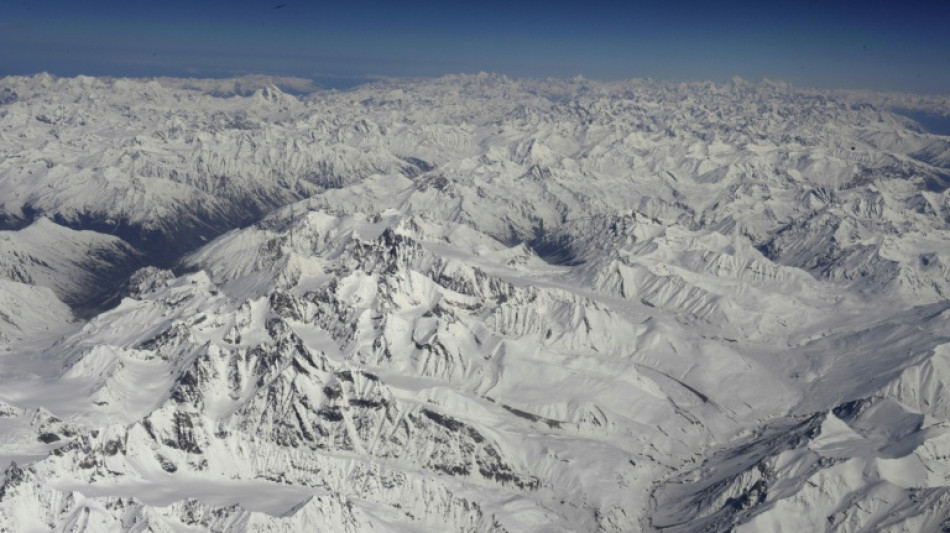
Pilgrims seeking peace caught in deadly Nepal-Tibet floods / Photo: © AFP/File
They came to the Himalayas seeking spiritual renewal, drawn by Tibet's sacred, snow-capped Mount Kailash.
Instead, many pilgrims were caught in deadly floods that tore through the Nepal-Tibet region, wiping out entire villages.
"I saw two buses carrying Indian pilgrims to Kailash Mansarovar," said 27-year-old Laloma, a Nepali mother.
She was rescued on Thursday from Nepal's devastated area of Syabrubesi, along with her infant son and husband, after sheltering for a freezing night in a school. The buses were swept away, she said.
"They are all gone," she told AFP.
Mount Kailash is sacred to Hindus, Buddhists and Jains.
Hindus regard Kailash as the abode of deities Shiva and Parvati, while Tibetan Buddhists associate it with Mount Meru, which they say is the centre of the universe.
It is forbidden to climb the 6,638-metre-high (21,778-foot) mountain.
Instead, pilgrims undertake a roughly 52-kilometre (32-mile) contemplative circuit around its base, taking most walkers about three days.
For those en route or returning from the isolated, pyramid-shaped peak and bathing in the frigid ice waters of nearby Lake Mansarovar, across China's frontier with Nepal, it was meant to be a healing journey of peace.
But climate change is causing glaciers to melt worldwide, increasing the risks of glacial lake floods and glacial collapses.
On Wednesday morning, a tsunami-like wall of water and mud powered down, caused by a glacial collapse that sent a torrent of debris downstream, burying homes and sweeping away bridges.
More than 470 people are dead and upwards of 1,400 others are missing in both China and Nepal.
- 'Share your pain' -
Indian spiritual leader Sadhguru this year led devotees to Kailash, an annual pilgrimage growing in popularity, especially among Indians.
Thousands of Indians are reported to have undertaken the pilgrimage this year, as well as Hindus from other nations.
Sadhguru's "sacred walks", organised by his Isha Foundation, promised a journey to a place "of divine connection, where the veil between the physical and spiritual is thin".
On Thursday, he wept as he described his frantic calls to missing devotees, in a video message posted from Tibet to his several million followers.
Some 77 pilgrims were at the Nepal-China border office when floodwaters swept through the centre on Wednesday, he said in a post, alongside a terrifying video from the Chinese side of the frontier, when a wall of mud and debris crashed over the building.
"Literally, the entire group was there in the building, this is a terrible and extraordinary event," he said, as anguished wails from other pilgrims with him are heard over the video.
"All of us, including the volunteers and support teams are deeply anguished," the Hindu guru, whose real name is Jagdish Vasudev, added.
"To the families and loved ones of those in our group and hundreds of others who are affected in the region, I share your pain," he added.
"All phones are off, telecommunications are down, roads are blocked, we are unable to go there," he said, tears in his eyes.
For Indians, the pilgrimage to Kailash and Lake Mansarovar is organised annually by New Delhi's foreign ministry, in coordination with Chinese authorities.
It restarted in 2025 for Indians for the first time since a 2020 border clash.
- 'Pure intention' -
Logadarrsiny Raman, 26, from Malaysia, said four members of her family were among 17 Malaysians travelling with a Nepali travel operator.
Her parents, aunt and uncle had spent months planning the pilgrimage, which they regarded as a spiritual journey and fulfilment.
"They felt like this was the right time for them to go for this pilgrimage," Raman said, speaking to AFP in Kuala Lumpur.
"It was a very pure intention, and that's why they wanted to go together as a family."
She last exchanged WhatsApp messages with her father just after dawn in Nepal on Wednesday.
After that, the family heard nothing.
Raman said the travel agency told her its last contact with the group was at 8:18 am Nepal time, when they were travelling towards the Nepal-China border.
The flood crashed into the area where they last were soon after.
"I'm very anxious," she said. "My only hope is to hear back from them that they are safe."
She appealed for help locating her parents and the other Malaysian pilgrims.
"There's nothing else that we all want as a family," she said.
A.Davey--TNT