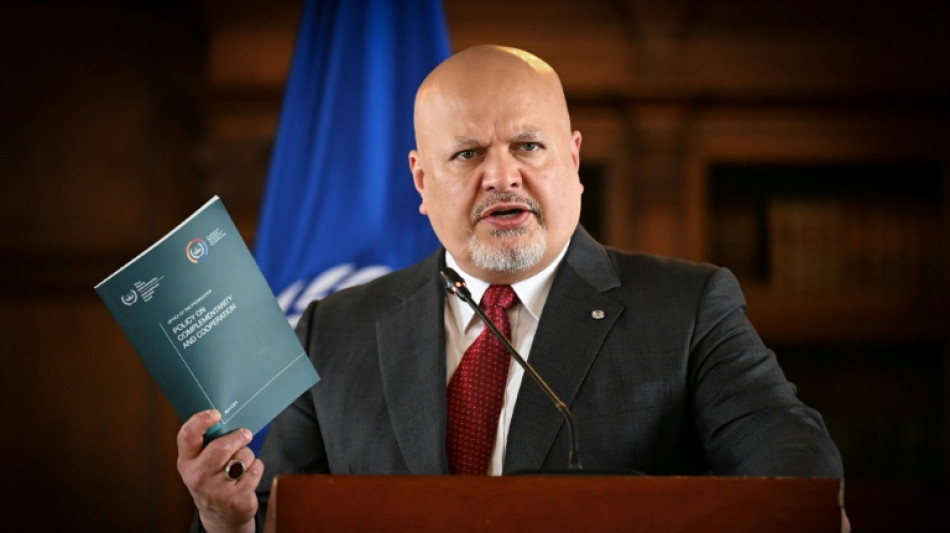
Karim Khan: Forensic ICC prosecutor with a tarnished legacy / Photo: © AFP
Karim Khan will go down in the history of the International Criminal Court as the prosecutor who clinched arrest warrants against the leaders of Russia and Israel but also as the one who "poisoned the atmosphere" within the institution.
Rigour and precision are the watchwords of this 56-year-old British lawyer when it comes to building a case against the alleged perpetrators of the world's most serious crimes.
But the forensic spotlight shifted to Khan himself after a female staffer accused him of sexual assault -- allegations he strongly denies -- ultimately costing him his job at the ICC.
At his swearing-in ceremony in 2021 as chief prosecutor of the Hague-based court, Khan said the ICC should be judged on its actions: "The proof of the pudding should be in the eating."
And by obtaining arrest warrants for Israeli Prime Minister Benjamin Netanyahu and Hamas leaders, he has shown he does not shy away from controversy.
Before that, he won an arrest warrant for Russian President Vladimir Putin, which led to Khan being placed on a wanted list in Russia.
The official has courted controversy throughout a career that has included defending former Liberian president Charles Taylor against allegations of war crimes in Sierra Leone.
Other high-profile clients have included Kenyan President William Ruto who faced charges of crimes against humanity at the ICC -- a case that was ultimately dropped.
He was also the lawyer for Seif al-Islam, son of the late Libyan leader Moamer Kadhafi.
Asked about "crossing the floor" -- working as both prosecutor and defence -- Khan told specialist journal OpinioJuris it helps lawyers stay "grounded".
It also prevents "corrosive traits such as thinking that defence counsel is the devil incarnate or that, as a prosecutor, you are doing 'God's work'," he added.
Initially criticised for dithering over atrocities in Gaza, Khan touched off a firestorm by applying for arrest warrants against Netanyahu and Hamas leaders.
Netanyahu called it a "moral outrage of historic proportions" while then US president Joe Biden described Khan's actions as "outrageous".
Even before Khan's applications, senior US Republicans had penned a letter threatening to bar him and his family from the United States, ending ominously, "you have been warned".
In his defence, Khan stressed: "This is not a witch hunt... It is a forensic process that is expected of us as international prosecutors."
– 'Aware of his achievements' –
Born in Scotland, Karim Khan studied at a private school in northern England, before reading law at King's College London.
He cut his teeth in international law at the former Yugoslav and Rwandan war crimes tribunals from 1997 to 2000, before representing survivors and relatives of victims of Cambodia's 1970s Khmer Rouge regime before a UN-backed court.
Other roles include a stint at the Special Tribunal for Lebanon, based in The Hague, created to try the assassins of former Lebanese Prime Minister Rafic Hariri in 2005.
With a nod to the arrogance some critics ascribe to him, the ICC selection panel described him as a "charismatic and articulate communicator who is well aware of his achievements".
"I did apply because I thought I could do the role. If the Search Committee thought this was arrogance, then I'm guilty as charged," retorted Khan.
His speeches feature a strong command of rhetoric, peppered with touches of British humour.
A member of the minority Ahmadiyya Muslim sect, he often punctuates his speeches with "Inshallah" (God willing).
"Karim Khan seems like a no-nonsense lawyer," Melanie O'Brien, visiting professor in international law at the University of Minnesota, told AFP.
An ICC prosecutor "has to have a certain fortitude because you know you are going to be up against people who don't agree with you and who don't agree with the court in general," she added.
But the vote by ICC members to sack him as prosecutor amid allegations of wrongdoing will tarnish his legacy.
"Even if they are only accusations, it disturbs us and it has poisoned the atmosphere of the court," Deputy Prosecutor Mandiaye Niang told AFP in an interview in December.
The accusations "are out there and that is enough to cast a veil of doubt over what we're doing", he said.
D.S.Robertson--TNT