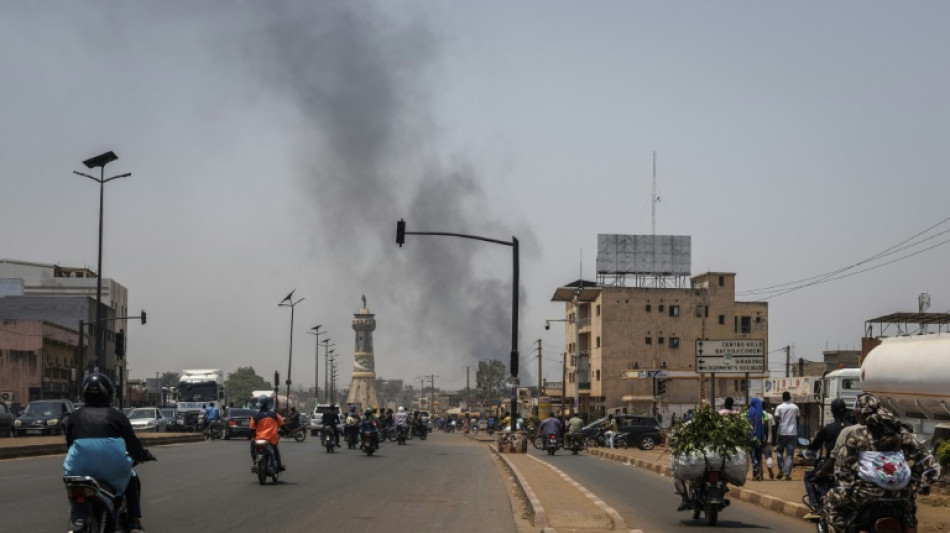
Attacks in Mali: What we know / Photo: © AFP
Mali has been plunged into an unprecedented security crisis after an alliance of Tuareg rebels and a jihadist group carried out synchronised attacks against the West African country's military leadership.
The two groups are the Azawad Liberation Front (FLA) coalition and the al-Qaeda-linked Jihadist Group for the Support of Islam and Muslims (JNIM). The FLA is made up of mainly Tuareg groups who want independence for Azawad, a territory in northern Mali.
Defence Minister General Sadio Camara, a key figure in the military regime, was killed in one attack, his family and government sources said Sunday.
Mali's army says it has been engaged in fierce fighting against the attackers since Saturday morning.
Here is what we know:
- Tuareg rebels in Kidal -
FLA fighters said Sunday they had full control of Kidal, a key town in the north.
Fighting appears to have stopped for the moment in Gao, another northern town, with rebels positioned on the outskirts.
The situation remains "confusing" in Sevare, central Mali, where gunfire was still ringing out in some areas, said one local official.
On Sunday afternoon, calm returned to Kati, a junta stronghold just 15 kilometers (9 miles) from the capital Bamako, after gunfire in the morning, one resident told AFP.
- Defence minister killed -
General Camara, 47, was killed Saturday when an explosive-laden car detonated outside his home, an attack claimed by the jihadist JNIM group.
- Tuaregs cut deal with Russians -
FLA fighters said they had reached an agreement to allow Russian Afrika Korps soldiers to withdraw from a camp where they had been entrenched since Saturday.
"The Russian fighters in Kidal have decided to leave their position," a diplomatic source told AFP. "They are coordinating their departure with the FLA rebels."
A resident of Kidal told AFP he had seen a military convoy leave the town.
- The junta leaders -
General Assimi Goita, the head of the junta, has neither been seen nor heard from since the attacks began.
A Malian security source told AFP he had been "evacuated from Kati on Saturday and is in a safe location" at a "special forces camp" near Bamako.
Security sources said head of intelligence General Modibo Kone and military Chief of Staff General Oumar Diarra were wounded during Saturday's attacks in Kati.
- 'Hunt' -
Mali's army said statement Sunday: "The hunt for armed terrorist groups continues in Kidal, Kati, and other locations across the country."
The military has imposed curfews, stepped up patrols and reinforced checkpoints across the country.
On Saturday evening, Mali's military rulers said the attacks had resulted in 16 civilian and military injuries and "limited material damage".
mk-sd-lar-str-bdi/gv/jj
V.Allen--TNT