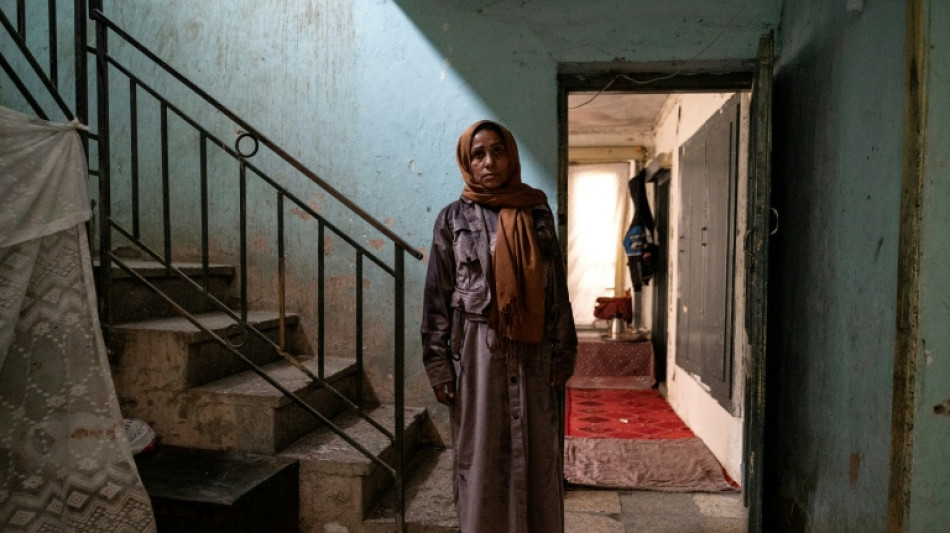
Afghan mother seeks justice after Pakistani bombing kills hundreds / Photo: © AFP
Samira Muhammadi hopes an international investigation can "extinguish" her pain after a Pakistani bombing killed her son and hundreds of other Afghans in the capital Kabul last month.
The March 16 attack hit a drug treatment centre and killed 411 people, according to Afghan officials.
A United Nations source, speaking to AFP on condition of anonymity, said they had verified at least 250 killed, with more still missing.
"There should be investigations on this... Like me, many mothers lost their sons, many women lost their husbands and many sisters lost their brothers," Muhammadi, 43, said at her home, where she scrolled through photos of her eldest son.
Afghanistan and Pakistan have been locked in an escalating conflict over claims from Islamabad that Kabul is harbouring militants responsible for cross-border attacks, which the Taliban government denies.
Pakistan has maintained it struck a military installation and did not respond to AFP questions about a possible probe into the deadly Kabul bombing.
AFP journalists at the scene in the hours after the attack saw dozens of bodies, including some that had been torn apart and burned.
The force of the blast made it difficult to identify some of the victims, the Norwegian Refugee Council, a humanitarian NGO, said shortly after visiting the site.
Muhammadi's 20-year-old son, Aref Khan, had become addicted to methamphetamine while working at a slaughterhouse in Iran alongside his mother.
"His coworkers told him the drug would help him stay awake," she said.
The family returned to Afghanistan a few months ago and tried to build a life in Kabul, with Khan working as a day labourer while Muhammadi found employment as a domestic cleaner.
But Afghan authorities had her son admitted to the "Camp Omid" rehabilitation centre in eastern Kabul to deal with his addiction.
"I sat with him and recorded a video of him, and he was having his food," recounted Muhammadi, who had brought her son supplies just hours before the attack.
"Usually, when there is a war, the military places are targeted or hit, so why did they (Pakistan) hit the hospital?" she said.
- Little chance of prosecutions -
Seventeen international humanitarian NGOs, including War Child UK, condemned the bombing, noting that hospitals must not be attacked.
Amnesty International, Human Rights Watch and the UN High Commissioner for Human Rights have called for an independent investigation.
The latter said those responsible should be "held to account in line with international standards".
The Taliban government told AFP that it has given media, diplomats and NGOs access to the site and has "shared the evidence".
Richard Bennett, the UN special rapporteur on Afghanistan, told AFP: "The initial responsibility actually falls on the alleged perpetrator of human rights violations, which is Pakistan."
Kenneth Roth, a visiting professor at Princeton University in the United States, said he "would hope that Pakistan would want to know what went wrong" after "many innocent people died".
States are generally reluctant to question themselves, but "even the Pentagon investigates why it struck and killed so many children in a school in Iran", said Roth, a longtime former Human Rights Watch executive director.
Several victims' relatives said they would have more confidence in an investigation from international institutions.
The UN mission in Afghanistan (UNAMA) has a mandate to investigate the impact of the conflict on civilians in the country and, therefore, the bombing.
"This process can take some time, especially in mass casualty events such as this one, and is ongoing," the agency told AFP, adding that it relies on sources including witnesses and doctors, as well as examinations of affected sites.
If it was found to be "an intentional or reckless attack on civilians, this attack could clearly lead to criminal charges", Roth told AFP.
While UNAMA does not have the power to press charges, the International Criminal Court (ICC) has jurisdiction over war crimes committed in Afghanistan, and can pursue even nationals from non-member states. But it tends to look at patterns rather than individual incidents.
"So even though there was one very unfortunate alleged crime, I don't think it would prosecute that without a pattern of misconduct," Roth said, referring to the ICC.
No one has been convicted internationally for recent strikes on health facilities in Gaza, Ukraine, Sudan or Myanmar.
"The lack of prosecutions encourages these war crimes," said Roth.
In Kabul, Muhammadi remained determined to seek justice despite the uphill struggle.
To "investigate why a 20-year-old, who had been taken to the hospital for treatment, was killed and burnt," she said.
"If we do not ask about this now, we will probably experience the same harm again."
F.Hammond--TNT