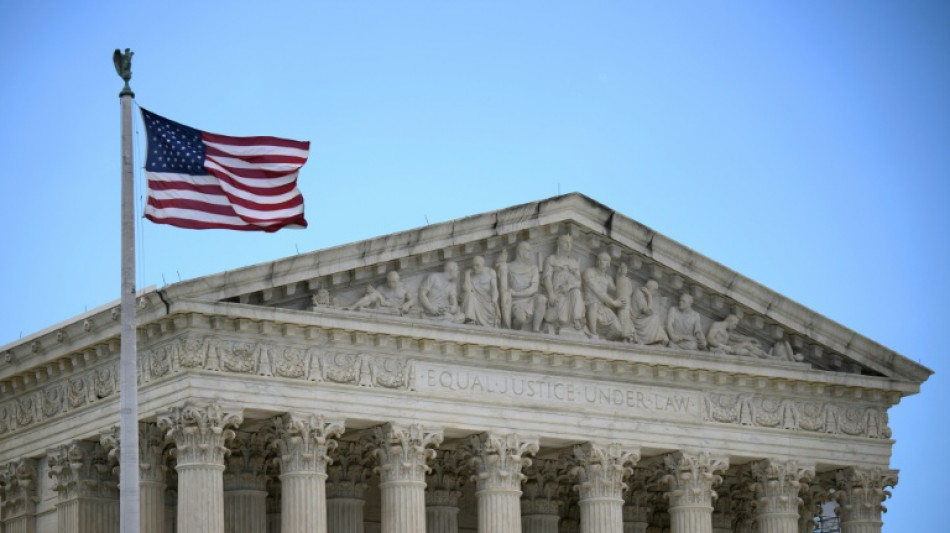
Supreme Court hears landmark citizenship case -- with Trump in audience / Photo: © AFP/File
The US Supreme Court was weighing Donald Trump's historic bid to end birthright citizenship on Wednesday -- with the Republican president smashing protocol by sitting in the audience.
The landmark case is a pillar in Trump's attempts to restrict immigration and his decision to attend oral arguments is unprecedented for a sitting president.
Trump left the hearing following the presentation by his solicitor general, John Sauer, and did not remain for the arguments of American Civil Liberties Union (ACLU) attorney Cecillia Wang, who is defending birthright citizenship.
Trump signed an executive order on his return to the White House last year decreeing that children born to parents in the United States illegally or on temporary visas would not automatically become US citizens.
Lower courts blocked the move as unconstitutional, ruling that under the Citizenship Clause of the 14th Amendment nearly everyone born on US soil is an American citizen.
Sauer told the court that "unrestricted birthright citizenship contradicts the practice of the overwhelming majority of modern nations" and "demeans the priceless and profound gift of American citizenship."
"It operates as a powerful pull factor for illegal immigration and rewards illegal aliens who not only violate the immigration laws but also jump in front of those who follow the rules," he said.
It also encourages what Sauer called "birth tourism," in which foreigners come to the United States solely to give birth.
Several of the justices on the conservative-dominated Supreme Court appeared skeptical of the bid to end birthright citizenship.
Chief Justice John Roberts, a conservative, asked Sauer how common "birth tourism" is before pointing out that regardless of the numbers it would have "no impact on the legal analysis" of the case.
"We're in a new world now," Sauer said, "where eight billion people are one plane ride away from having a child who's a US citizen."
"Well, it's a new world but it's the same Constitution," Roberts replied.
- 'Quirky' -
The 14th Amendment states that "All persons born or naturalized in the United States, and subject to the jurisdiction thereof, are citizens of the United States."
It does not apply to persons who are not subject to US jurisdiction -- the children of foreign diplomats, for example -- and Roberts said the administration appeared to be seeking to expand the exceptions "to a whole class of illegal aliens," a move he described as "quirky."
Justice Brett Kavanaugh, another conservative, asked Sauer why he was citing the birthright policies of other nations.
"We try to interpret American law with American precedent based on American history," Kavanaugh said. "Why should we be thinking about...other countries in the world? I'm not seeing the relevance as a legal, constitutional interpretive matter."
Wang, the ACLU attorney, told the justices a rejection of birthright citizenship would call into question "the citizenship of millions of Americans past, present and future."
"Ask any American what our citizenship rule is, and they'll tell you, everyone born here is a citizen alike," Wang said. "That rule was enshrined in the 14th Amendment to put it out of the reach of any government official to destroy."
Trump has spent the first year of his second term asserting extraordinary executive powers while attempting to sideline Congress and routinely pressuring the courts, calling judges "rogues" and "criminals."
The Trump administration is arguing that the 14th Amendment, passed in the wake of the 1861-1865 Civil War, addresses the rights to citizenship of former slaves and not the children of undocumented migrants or visitors.
Trump's executive order is premised on the notion that anyone in the United States illegally, or on a visa, is not "subject to the jurisdiction" of the country and therefore excluded from automatic citizenship.
The Supreme Court rejected such a narrow definition in a landmark 1898 case involving a man who was born in San Francisco to parents from China.
Conservatives have a 6-3 supermajority on the high court and three of the justices were appointed by Trump.
If the Supreme Court rejects ending birthright citizenship, it would be the second major loss for Trump this term -- the justices struck down most of his global tariffs in February.
A decision in the case is expected by late June or early July.
A.Davey--TNT