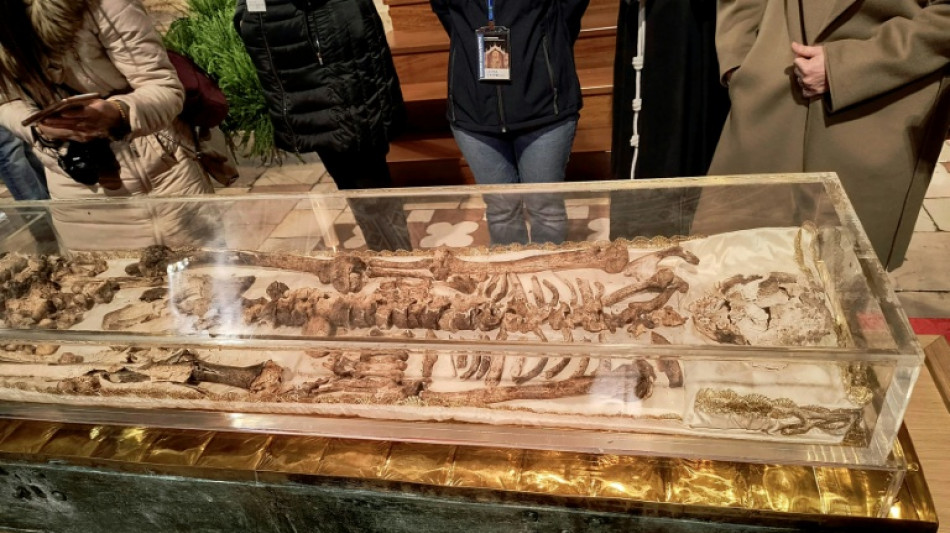
Thousands of pilgrims visit remains of St Francis / Photo: © AFP
A long line of pilgrims and visitors snaked outside the Basilica of Saint Francis of Assisi in Italy on Sunday as his remains went on public display for the first time.
Many families with children, couples and elderly people could be seen under a large white marquee, waiting their turn to see the 13th century skeleton of Italy's patron saint.
After passing through metal detectors, groups of about 750 people were being allowed into the hill town basilica's lower church every half an hour starting from 7:00am.
The Franciscan order says some 400,000 people have reserved visits to see the remains, which will be on display until March 22.
"It was a very moving morning -- a unique event and I appreciated it hugely," Nicoletta Benolli, 65, told AFP as she came out of the church under a bright winter sun.
St Francis founded the Franciscan order after renouncing his wealth and devoting his life to the poor.
- 'Very intense' -
The remains are being shown in a plexiglass case by the richly-decorated church's altar for the 800th anniversary of his death.
The public are allowed to touch the outer glass case.
Being so close to the remains "makes things very real," said Benolli, who had travelled from Verona in northern Italy.
"Sometimes we doubt but here, in these moments, we have the truth in front of us. We have the chance to see it and touch it".
As they viewed the remains laid out on a white silk sheet, many pilgrims made the sign of the cross, others kneeled down.
One visitor touched her rosary beads on the case. Many had tears in their eyes.
Apart from previous exhumations for inspection and scientific examination, the bones of Saint Francis have only been displayed once, in 1978, to a very limited public and for just one day.
"Being close to such a model of saintliness transmits something to the soul.
"We can almost hear Francis's message when passing by as if he was speaking to us. Even if it is a quick passage, it is very intense," said Nicola Urlandini, 35, who came with his girlfriend.
Giulio Cesareo, director of communications for the convent of Assisi and himself a Franciscan friar, said that "you can see with the naked eye that these remains are really consumed but not consumed by time but by fatigue, by privations, for this man who walked enormously and slept in caves.
The skull was also damaged when the body was moved into the basilica in the 13th century.
Rosa Padhilete, a Franciscan nun who came from Naples, said she felt an "immense, inexplicable joy" seeing the remains.
"Contemplating in silence the mortal remains of St Francis, (it is) as if he was really alive and that revives hope for those of us who are still on Earth," she said.
A.Little--TNT