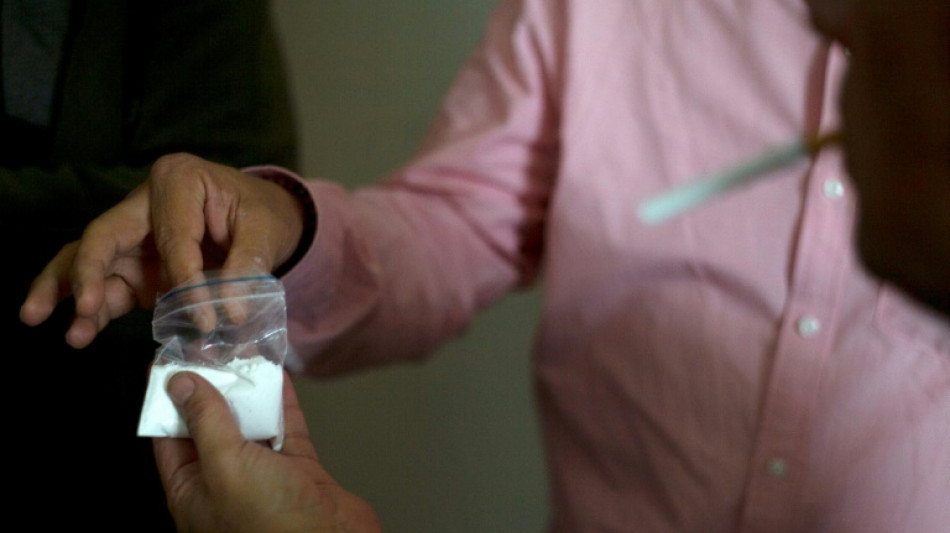
Strike kills guerrillas as US, Colombia agree to target narco bosses / Photo: © AFP/File
Colombia killed seven guerrilla fighters Wednesday after presidents Gustavo Petro and Donald Trump vowed to jointly target narco bosses, prompting a powerful cartel to exit peace talks in the violence-blighted country.
Petro and his US counterpart agreed at the White House on Tuesday to joint military and intelligence actions against three Colombian capos, who together produce and supply much of the world's cocaine.
Colombian Defense Minister Pedro Sanchez named the targets as Ivan Mordisco, Colombia's most wanted rebel; Chiquito Malo, commander of the Gulf Clan cartel; and Pablito, an ELN guerrilla leader operating near the Venezuelan border.
The Petro-Trump pact upended years of sputtering Colombian efforts to negotiate peace with criminal groups.
On Wednesday, Colombia's military killed seven members of the ELN or National Liberation Army, which controls key drug-producing regions.
US troops were not involved in the operation near the Venezuela border, an army official said, and a military source said the attack was planned before Tuesday's Trump-Petro talks.
The ELN is the oldest surviving guerrilla group in the Americas, and funds its activities with drug trafficking and other illegal activities.
Colombia produces about 70 percent of the world's cocaine, of which the United States is the largest consumer.
After Tuesday's announcement of joint action against narco bosses including its commander, the Gulf Clan -- Colombia's most powerful cartel-- said it was "temporarily" withdrawing from peace talks that started in Qatar about five months ago.
- 'Total peace' in peril? -
Sanchez said Wednesday that Venezuela would be asked to join the anti-narco campaign.
Colombian governments have long accused Caracas of funding and offering safe haven to leftist guerrilla and cocaine-trafficking groups.
But after the ouster of Venezuelan president Nicolas Maduro in a US military operation on January 3, there are hopes security cooperation can improve.
Curtailing the flow of drugs from South America to the US has long been a stated goal of Trump.
For decades, Colombia was Washington's closest partner in Latin America, with billions of dollars flowing to Bogota to boost its drug fight.
But relations strained under Petro, Colombia's first leftist president on whose watch coca production and cocaine exports surged even as he came under domestic pressure for insisting on negotiating a "total peace" with armed groups.
Petro has publicly bickered for months with Trump, who has branded him a "sick man who likes making cocaine" and warned him to "watch his ass."
In an olive branch to Trump hours before their first face-to-face meeting, Petro extradited an accused drug lord to the United States after a months-long suspension on such transfers.
- 'Defend the homeland' -
Rightwing paramilitary groups emerged in the 1980s in Colombia to fight Marxist guerrillas who had taken up arms against the state two decades earlier with the stated goal of combating poverty and political marginalization, especially in rural areas.
A plethora of armed groups adopted cocaine as their main source of income, the genesis of a rivalry for resources and trafficking that continues to pit them against each other and the state.
Colombia has enjoyed a decade or more of relative calm since a peace agreement saw the FARC guerrilla army disarm in 2017.
But there has been a surge in violence ahead of 2026 presidential elections, with bomb and drone attacks in parts of the country and the assassination of a presidential hopeful.
One of the men on the target list, Mordisco, has threatened to disrupt the presidential election in May in response to military strikes.
He leads a dissident faction of FARC fighters who rejected the 2016 peace agreement.
In January, after Maduro's ouster, ELN commander Antonio Garcia, who is not on the list, vowed to join Mordisco "to defend the homeland against foreign aggression."
A Colombian observer group said Wednesday a third of the national territory -- more than 300 municipalities -- are at risk of electoral violence.
F.Adams--TNT