'Our children are next' fear Kenyans as drought wipes out livestock / Photo: © AFP
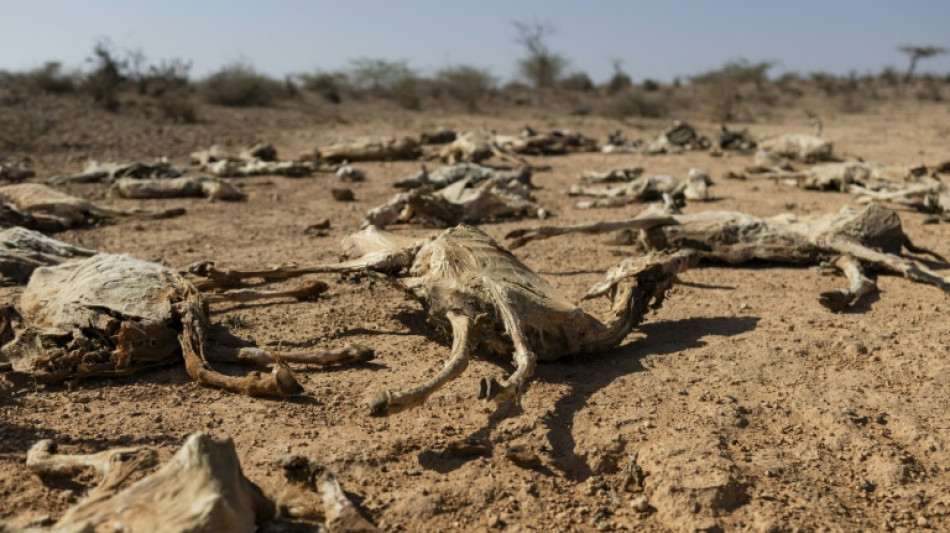
In drought-hit northeastern Kenya, villagers have been forced to drag their dead livestock to distant fields for burning to keep the stench of death and scavenging hyenas away from their homes.
Mandera county along Kenya's borders with Ethiopia and Somalia has seen no rain since May and is now on the point of a full-blown water emergency.
"I have lost all my cows and goats, and burned them here," Bishar Maalim Mohammed, 60, a resident of Tawakal village, told AFP.
In his village, where most are pastoralists relying heavily on their animals, the only remaining bull can no longer stand. He has lain in the same spot for nearly a week, severely dehydrated with bones protruding through his skin, as his owner watches helplessly.
In the nearby town of Banissa, the man-made watering hole that once held 60,000 cubic metres of water is dry, leaving a barren expanse that children have turned into a playground.
Herds of goats, cattle and camels must now trek up to 30 kilometres (20 miles) to the nearest watering hole at Lulis village, jostling for the remaining water that officials are rationing.
"In two weeks this water will be finished... we are in a very bad state," said local resident Aden Hussein, 40.
More than two million people across 23 counties in Kenya are facing worsening food insecurity after the October–December short rains failed, with rainfall two-thirds below average.
The National Drought Management Authority has placed about nine counties on alert, while Mandera County is at the "alarm" phase, one step short of an official emergency.
The Famine Early Warning Systems Network recently said 20 to 25 million people in Kenya, Somalia and Ethiopia need humanitarian food assistance, more than half because of drought.
"Our children are the next ones who are going to die," said Maalim Mohammed in Tawakal.
- 'No milk at all' -
At Banissa's main hospital, an influx of severely malnourished children -- some arriving from neighbouring Ethiopia -- has overwhelmed the paediatric ward.
During a recent visit, AFP saw eight children suffering from severe malnutrition, including a 32-month-old girl weighing just 4.5 kilograms and another child who had been readmitted after returning to a household with no food.
"Children are not getting an adequate diet because of this drought...they depend on camel and goat milk but there is now no milk at all," said hospital nutritionist Khalid Ahmed Wethow.
The hospital, which serves around 200,000 people, has only eight tins of therapeutic milk remaining in its paediatric unit, which were expected to run out this week.
The unit depends on donations from organisations such as the World Food Programme, but with Western countries slashing aid budgets over the past year, it has not received any supplies in six months.
The Kenyan government and aid groups such as the Red Cross have increased water-trucking efforts, food assistance and cash support, but say they cannot keep up with demand.
- 'Tried to escape' -
In desperation, Bishar Mohamed, no relation to the first villager, travelled more than 150 kilometres with his herd of 170 goats in search of pasture. Around 100 died along the way and the rest died after he returned home to Hawara village.
"We have tried to escape in search of better places and failed," he told AFP, standing in a field where the carcasses of his goats were piled up. "I have been moving by foot... my head is severely in pain... we are thirsty."
In nearby Jabi Bar village, enrolment at a nearby school has dropped by more than half, headteacher Ali Haji Shabure told AFP.
"Only 99 children are in school, most of them have left with their parents," Shabure said.
The next rains -- if they come -- are not due before April.
Bishara Maalim, a mother of 10 in Hawara, has only one hope for her children: "May God save them."
A.Wood--TNT