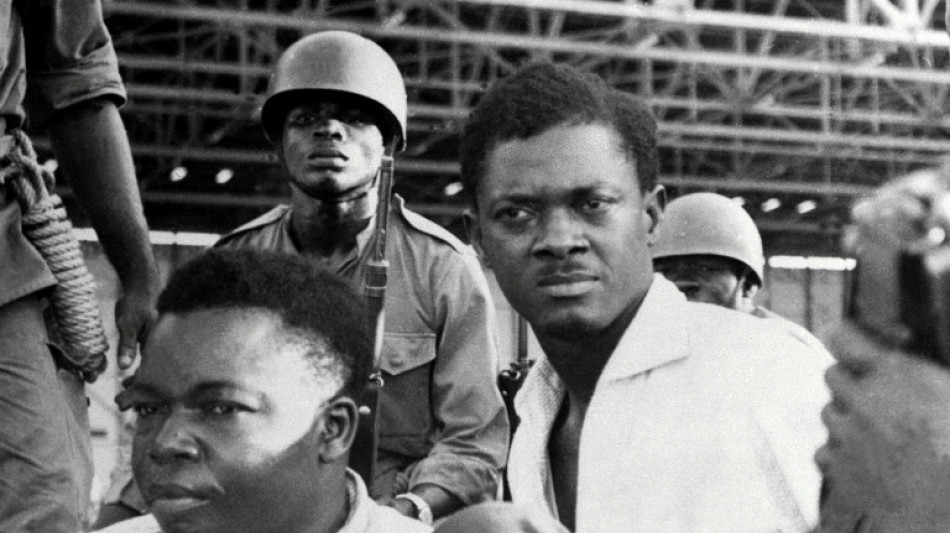
Belgian court weighs trial for ex-diplomat over Lumumba killing / Photo: © AFP
A Belgian court will hold a hearing Tuesday on whether a former senior diplomat should go on trial over the 1961 killing of Congolese leader Patrice Lumumba.
The family of the independence icon has been pushing for the past 15 years for what they say is a long-overdue legal reckoning over the complicity of Belgian officials in his murder.
"This is not about revenge, but about a thirst for knowledge," Roland Lumumba, one of Patrice's sons, told AFP.
"Millions of people would like to know the truth."
Some 65 years after Lumumba was executed and his body dissolved in acid by separatists with the help of mercenaries from former colonial power Belgium, only one ex-official is still alive to face justice.
That is 93-year-old Etienne Davignon, a one-time European Commissioner, who was a novice Belgian diplomat at the time of Lumumba's killing.
He is accused by Belgian federal prosecutors of involvement in the "unlawful detention and transfer" of Lumumba, as well as "humiliating and degrading treatment".
Davignon has always denied Belgian authorities' involvement in the murder, and his lawyer declined to comment to AFP before Tuesday's closed-door hearing.
- 'Major colonial crimes' -
The killing of Lumumba -- who became prime minister at independence in 1960 -- is one of the many dark chapters in the grim history of Belgian involvement in what became modern-day Democratic Republic of Congo.
His family says there was a "vast conspiracy" involving Belgian officials to eliminate the Congolese leader.
"Refusing this trial would amount to definitively confirming the impunity for major colonial crimes," said Christophe Marchand, a lawyer for the family.
The court is expected to deliver its decision on whether to hold a trial within weeks. Marchand said he hopes it would then take place in early 2027.
The Belgian probe into potential "war crimes" in the Congo has already led to one macabre discovery: one of Lumumba's teeth, the only known remains of the assassinated leader.
The tooth was seized from the daughter of a deceased Belgian police officer who had been involved in the disappearance of the body.
It was returned to DRC authorities in a coffin during an official ceremony in 2022.
During the handover, then Belgian prime minister Alexander De Croo reiterated the government's "apologies" for its "moral responsibility" in Lumumba's disappearance.
De Croo pointed the finger at Belgian officials who at the time "chose not to see" and "not to act".
After entering the diplomatic service in 1959, Davignon rose through the ranks after his early involvement in Congolese independence talks.
In the early 1980s, he gained more prominence when he was named a vice-president in charge of industry of the European Commission.
R.Evans--TNT