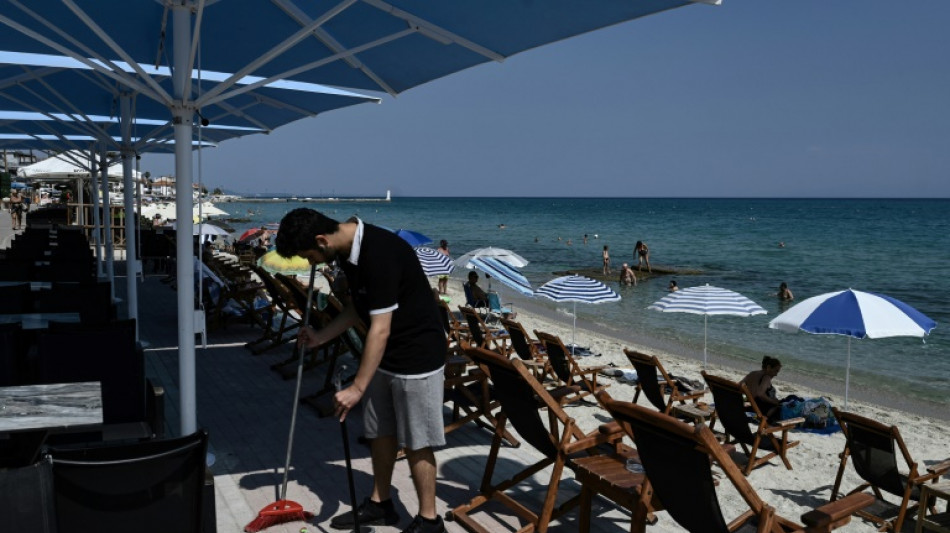
Staff shortages bite as Greeks shun low-paid tourism jobs / Photo: © AFP
Greek tourism student Katerina quit within a month of starting work at a five-star hotel in Halkidiki, one of the country's top destinations, because she said conditions were so dire.
Beyond the bad pay, the 22-year-old told AFP that her working and living conditions were "miserable and unacceptable".
Millions holiday in Greece every year, but its vital tourism industry is finding it harder and harder to recruit Greeks to look after them.
"I was asked to work in any department of the hotel where there was a need, from service to cleaning," said Katerina, a tourism and marketing student, who would not give her surname for fear of putting off future employers.
"We were housed in a space with eight other people, without air conditioning or laundry facilities," she added.
Despite a record year in 2024 with 36 million visitors -- and equally robust forecasts for this season -- operators say they are short of thousands of staff.
Studies show one in five jobs are perennially unfilled, with similar forecasts for this year.
Markos Kesidis, who runs a beach bar and a small hotel in Halkidiki, said he has to wait on his customers himself.
- 'Impossible' to find help -
"I need 20 people for the beach bar. Right now it's impossible to find that many," he said.
Tourism brought in 30.2 billion euros ($35 billion) last year, according to the Greek Tourism Confederation (INSETE) -- roughly 13 percent of Greece's GDP.
But the sector was short of 54,000 workers, said the Research Institute for Tourism (ITEP). Its chair Konstantina Svynou said that is unlikely to change.
"For this reason, many hotel owners turn to seeking temporary staff from third countries," Svynou told AFP, meaning from outside the EU.
Nearly half of Greek hoteliers intended to hire from countries outside the bloc to fill more than 28,000 jobs, ITEP research indicated, she said.
Most tended to be for unskilled positions such as housekeeping, dishwashing and cleaning.
Hotel staff in Greece earn on average between 950 and 1,000 euros ($1,150) a month, plus bonuses.
In Halkidiki, local hotel associations have attempted to hire workers from nearby refugee centres, but the uptake has not been high.
"A total of 110 individuals initially expressed interest, but only 10 are currently working in the area's hotels," said Grigoris Tasios, head of the Halkidiki Hoteliers Association.
"Most are afraid that when the tourist season ends, they might no longer find accommodation in the reception centres" as asylum arrivals tend to go up in the summer, he said.
Tasios said one in 10 posts are vacant in hotels in the northern Greek peninsula, famous for its sandy beaches.
Its 540 hotels nominally employ 14,000 people.
"Several have hired workers from India and the Philippines" to get by, he said.
- Asian and African workers -
The majority of staff on some of the heavily-touriste Greek islands tend to come from outside the EU.
"Only 14 of the 70 staff at the hotel where I work are Greek," said Maria Angeli, 54, a linen keeper in a luxury hotel on the island of Santorini.
"My other colleagues are from countries like Nepal, Bangladesh and African nations,"she said.
"Greeks, particularly young people, are now more reluctant to work in tourism businesses. Often the working and living conditions are not good, and this is a deterrent," she added.
Catering is also beleaguered by staff shortages, although the exact statistics are unknown.
However, restaurants and other catering businesses on some islands are closing for a day a week because they can't get enough help.
"Finding staff is challenging anyway, but labour law restrictions make it even harder for our businesses to operate and remain viable," said Markos Kesidis, owner of a beach bar in the Halkidiki area.
"Many want to work seven days a week due to the seasonality of the work, but are not allowed to, which is absurd," he said.
E.Cox--TNT