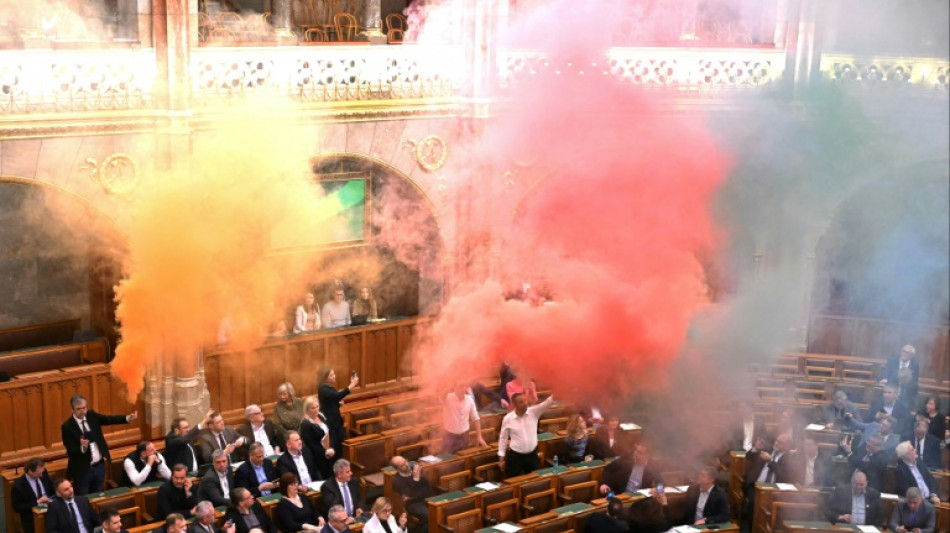
Hungary passes bill against annual Budapest Pride march / Photo: © AFP
Hungarian lawmakers passed a bill on Tuesday aimed at banning Budapest's annual Pride march, the latest in a series of measures under Prime Minister Viktor Orban's government, which critics say curtail the rights of the EU country's LGBTQ community.
Orban's government has repeatedly criticised LGBTQ people and gradually been rolling back on their rights in the name of "child protection" in recent years.
"We won't let woke ideology endanger our kids," the nationalist leader wrote on X.
Thousands of people chanting "We are not afraid!" rallied in central Budapest on Tuesday night to protest against the vote, which marks the latest setback to LGBTQ rights around the world.
Protesters also blocked access to a bridge in the capital.
Engineer Laszlo Donat, 40, told AFP that he joined the rally because "we've had enough in Hungary", adding that it was time to "restore democracy" by "replacing this... corrupt, gangster, mafia system".
The legislation -- drafted by Orban's governing Fidesz-KDNP coalition -- aims to ban the Pride march on the basis that it infringes on Hungary's much-criticised "child protection" law, making it possible to fine those who attend the event.
- Smoke flares, Soviet anthem -
The adopted bill stipulates that it is "forbidden to hold an assembly in violation of" a 2021 law that bans the "promotion and display" of homosexuality to minors.
It amends several laws, including one governing the rights of assembly, which now states that only events "respecting the right of children to proper physical, mental and moral development may take place".
Organisers or participants of a banned event could risk fines of up to 500 euros ($545), with police being allowed to use facial recognition tools to identify potential offenders.
After being submitted on Monday morning and fast-tracked under an exceptional procedure, the legislation passed the 199-seat National Assembly with 136 votes in favour, 27 against, and others abstaining from the vote.
Deputies of the right-wing Jobbik and the far-right Our Homeland party also supported the measure.
Opposition politicians from the liberal Momentum disrupted the vote by shouting, lighting flares and playing the old Soviet Union anthem.
In his annual state of the nation address in February, Orban warned Pride organisers against preparing for this year's event, saying it would be "a waste of money and time".
Last month, the government said the Pride march would no longer "be tolerated" in the "same public form" as previously.
- Used as a 'scapegoat' -
Since returning to lead the country in 2010, Orban has faced criticism for weakening democratic institutions, including accusations of having gradually undermined the rule of law.
Emboldened by his ally US President Donald Trump returning to the White House, Hungary's nationalist leader has ramped up his rhetoric against opponents and announced a slew of legislative measures.
On Saturday, Orban called his political enemies, judges, the media as well as NGOs "stinky bugs" and promised to "eliminate the entire shadow army".
Later in April, parliament is slated to vote on constitutional amendments aimed at "temporarily stripping" dual nationals of their Hungarian citizenship deemed security threats or stipulating that a person is "either a man or a woman".
Critics accuse Orban of trying to win over far-right voters with the latest measures as he attempts to hold off the threat of former insider-turned-challenger Peter Magyar, with elections scheduled for next year.
"It is easy to win votes by restricting the rights of a minority in a conservative society," Szabolcs Hegyi, a legal expert at the Hungarian Civil Liberties Union (TASZ) pointed out.
He said it is "very regrettable" that legislation that "severely curtails civil liberties" is being used to further "party interests", warning that it could lead to a slippery slope.
March organisers have expressed defiance, saying they will go ahead with the 30th Budapest Pride on June 28.
People are "willing to come to Budapest Pride and show support... even if they have to pay fines," spokesperson Mate Hegedus told AFP.
"We won't be scared by the government who is using our minority, the LGBTQ community as a scapegoat" he stressed.
S.Mitchell--TNT