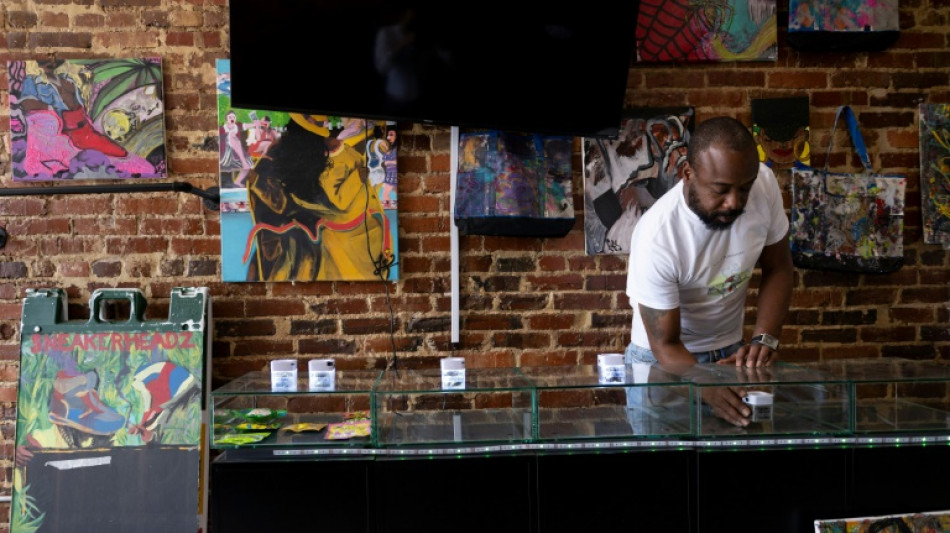
US pot use increasingly normal, but legality is hazy / Photo: © AFP
Buy a T-shirt, get a "gift" of weed: that's how some stores operate in Washington, exploiting a perceived loophole to sidestep a ban on selling cannabis in the US capital.
The situation is but one example of the knotty legality surrounding marijuana in America, despite a trend in recent years towards normalization.
"Business is great!" declares Forest "Ty" Hayward, 41, the proud co-owner of Sneaker Headz -- one of several "gifting shops" that have sprung up in a city now known for the everpresent fragrance of the flower.
Many are African-American owned, and are seeing a lively trade ahead of national marijuana day on April 20. Hayward sees his work as "a turning point for the Black community," which historically suffered a disproportionate rate of cannabis convictions.
Since 2014, Washington residents have been allowed to possess paraphernalia and two ounces of weed, gift some to others, use it on private property, and grow up to six plants. But Congress -- which controls the city's budget -- has barred legal sales.
Instead stores sell items like T-shirts and stickers, starting at around $30, with which customers also receive "presents" in the form of weed buds or gummies.
Cannabis was first outlawed at the federal level in 1937, "largely along racial reasoning, as well as to keep out immigrant workers or find ways to criminalize them," Morgan Fox, political director of advocacy group NORML, told AFP.
The 1970s brought the "War on Drugs," which likewise disproportionately hit minorities -- before the medical marijuana movement took root in the 1990s, and in 2012 the first states made recreational cannabis legal for adults.
Today, 18 of the 50 US states plus Washington have legalized recreational weed use, while 37 have medical cannabis laws on the books.
But since the drug remains a controlled substance at the national level, everyone involved is still technically breaking the law of the land.
The ban makes it difficult to access banking services, stops federal funding for medical marijuana research, prevents interstate commerce, and federal regulation on best practices and protocols for marijuana.
What's more, "these programs that have been erected in a growing number of states that now encompass a majority of Americans could be shut down at any moment, if a politically unsympathetic regime were in charge," said Fox.
Former president Donald Trump's administration rescinded a directive instructing federal prosecutors not to interfere with state level cannabis programs -- but ultimately prosecutors didn't see this as a good use of their resources.
- Legal trouble -
Still, sticky legal situations can arise.
After Canada fully legalized cannabis in 2018, US Customs and Border Patrol officers began issuing lifetime entry bans to Canadians who responded "yes" when asked at checkpoints if they had ever consumed the drug.
The same agency this month issued a warning to residents in New Mexico that it would continue to prosecute offenders caught with the substance at highway checkpoints, even after the state had legalized it.
Native American nations also encounter raids with the Bureau of Indian Affairs, despite the fact they live on nominally self-governing territories.
And in Washington, those caught smoking on federal grounds -- including iconic monuments like the Lincoln Memorial -- may have a run in with federal agents.
That's why it's vital to pass legislation at the national level, said Fox.
The House of Representatives has passed some bills, including as recently as this month, but it has yet to be brought before the Senate, where Republican opposition would likely nix it -- though younger conservatives are thought more cannabis friendly.
For now, the community is celebrating the progress they have won.
"I want to have a whole shebang, just remind everybody we're still here to give back to the community, get high and have a wonderful life," says Sneaker Headz' co-owner Kashous Solomon, 22.
A.Parker--TNT