RoboSense Robotics Revenue Expands as New Sensor and Joint Products Near Production
RoboSense reported rapid first-half LiDAR growth and outlined commercialization schedules for spatial cameras, tactile sensors and robotic joint modules.
RoboSense reported first-half 2026 revenue of 1.02 billion yuan, up 30.2 percent from a year earlier, as total LiDAR sales climbed 169.6 percent to 719,200 units. The company released the interim figures on Aug. 26 and said its robotics operation had become the main contributor to revenue and profit growth.
LiDAR sales for robotics rose 510.4 percent to 282,600 units. The segment generated nearly half of product revenue and became the largest source of gross profit. RoboSense said it works with almost 60 companies involved in embodied intelligence, including Unitree, AGIBOT and Fourier.
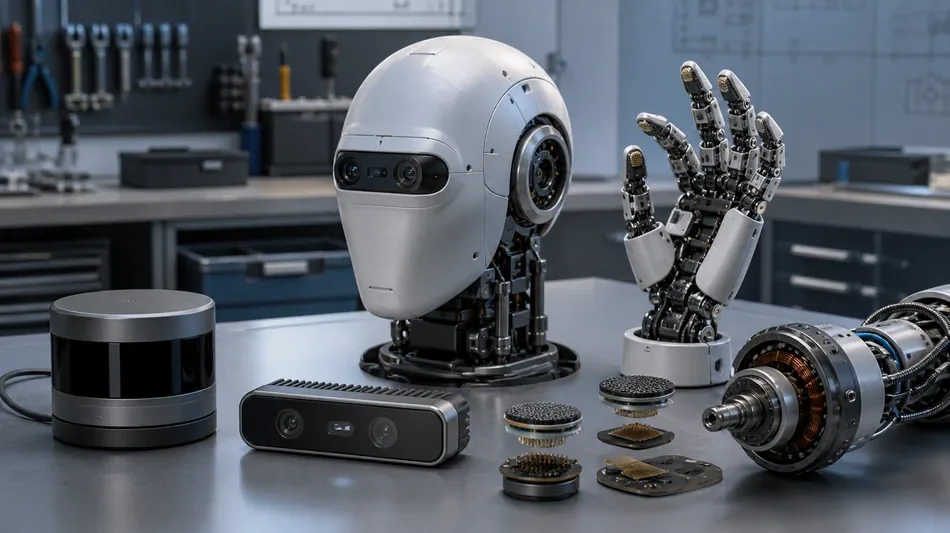
The company also detailed three product groups intended to move it beyond its original LiDAR business. It describes the categories as robotic “eyes,” “skin” and “muscle.” The first consists of spatial cameras using proprietary SPAD chips to align color and depth information and produce millimeter-level RGB-D output. The design is intended to support close-range robotic work under difficult lighting or in environments with little surface texture. Orders have been secured, deliveries are scheduled for the end of the third quarter and full mass production is planned for 2027.
The “skin” category includes visual-tactile and MEMS tactile sensors. RoboSense said the visual-tactile design simplifies the optical structure, cuts computing requirements and allows smaller components suitable for areas such as dexterous fingertips. Its MEMS product is intended to reduce drift and hysteresis associated with conventional electronic skin and can operate on finger pads. Development of both products is complete. The first enterprise mass-production program is due for commercial delivery by late September, followed by volume production in the fourth quarter.
Joint modules form the “muscle” category. They adapt miniaturized motor technology developed for RoboSense LiDAR systems to improve torque density and control accuracy. The first module has completed development and attracted initial orders numbering in the tens of thousands, with batch delivery scheduled to begin in the fourth quarter.
The three groups can be installed separately in robots or combined in data-collection systems. RoboSense said matching perception, touch and movement components to those used in deployed machines can reduce differences between training data and real-world operation.
The expansion draws on more than a decade of work in chips, optics, MEMS, precision electromechanics and large-scale manufacturing. During the first half, RoboSense introduced the Phoenix and Peacock chips under its Genesis SPAD-SoC architecture. The Peacock-powered E2, described as an exceptionally small high-precision ultra-wide-angle LiDAR, entered mass production and is expected to exceed 200,000 deliveries in the second half. The first automotive program using Phoenix is due to start production in the fourth quarter.
RoboSense is positioning itself as a multi-product robotics technology platform rather than a single-product LiDAR supplier. It is transferring engineering and manufacturing practices developed for automotive customers into robotics while expanding from perception equipment to tactile and actuation components.
L.Johnson--TNT