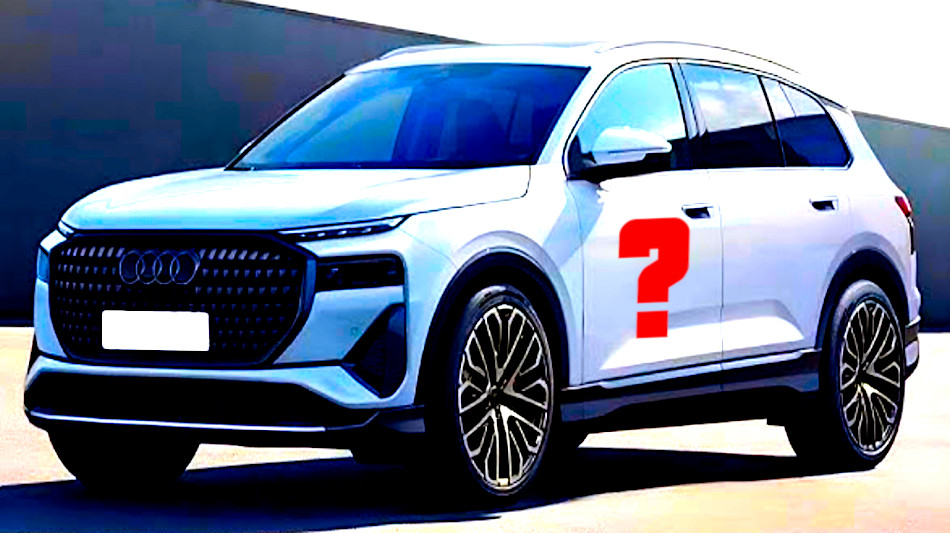
The National Times - Audi Q9 – how likely is it to become a reality?

Audi Q9 – how likely is it to become a reality?


Audi Q9 – how likely is it to become a reality?

The new Audi Q9 is not arriving at a moment of effortless supremacy. It arrives while Audi is renewing its range, trimming costs and trying to restore the full credibility of its premium promise. A flagship SUV above the Q7 is strategically sensible: more presence, more margin potential and more relevance in a highly profitable class. But that also raises the burden of proof.

That burden begins with the facts. Audi has confirmed the Q9, yet there is still no official final price and no published WLTP range. Nor has the production powertrain line-up been fully disclosed in public. So the central question can only be answered provisionally today: the Q9 is not justified by default; its eventual price and its real-world electrified usefulness will have to justify themselves.

Range is where the issue becomes especially delicate. If Audi launches the Q9 as an electrified combustion model or a plug-in hybrid, a merely decent figure will not be enough in 2026. Buyers in this class expect more than paper efficiency and a premium screen landscape. They expect genuine everyday usability, calm long-distance comfort, intelligent charging and powertrain logic, and the sense that this is modern mobility done convincingly rather than transitional technology sold expensively.

Change text size:

The price question is even sharper. In the luxury SUV segment, six-figure pricing no longer shocks anyone on its own. What buyers have become far less tolerant of are forced package structures, option lists that spiral quickly and cabins whose tactile quality does not always match the invoice. This is where Audi currently carries some baggage. The brand still stands for disciplined design, good road manners and technical ambition. But the old certainty that an Audi would automatically feel peerlessly premium inside is not as secure as it once was.

That is why the Q9 is more than another new model. It is a test of whether Audi can still define premium rather than merely charge for it. Online debate repeats the same complaints: too expensive, too much screen logic, too many glossy surfaces, too little substance in the details, too much configuration pressure. The Q9 itself also divides opinion. Some see it as the overdue flagship Audi needs. Others see it as proof that size alone no longer creates desirability or legitimacy.

The sober interim verdict is therefore clear: the Audi Q9 could become a strong flagship, but today neither its price nor its range can be called justified by default. The official values are missing, and so is the proof that Audi has fully restored the blend of material quality, usability and credibility that once came almost automatically with the brand. Audi remains an important premium marque. But it is no longer beyond challenge. The Q9 now has to prove that Audi is selling substance first and prestige second.

Featured

Dubai Police Unveil Next Generation of ‘Ghiath’ Smart Patrols Powered by BYD

In line with Dubai’s vision to lead in security, sustainability and smart mobility, Dubai Police, in partnership with Al-Futtaim, the exclusive distributor of BYD in the UAE, has launched the second generation of its ‘Ghiath’ smart patrol vehicles.The launch ceremony was attended by Lieutenant General Abdulla Khalifa Al Marri, Commander-in-Chief of Dubai Police, Stella Li, Executive Vice President of BYD Company, Omar Al Futtaim, Vice Chairman and Chief Executive Officer of Al-Futtaim, Major General Hareb Al Shamsi, Deputy Commander-in-Chief for Criminal Affairs, Major General Saif Muhair Al Mazrouei, Assistant Commander-in-Chief for Operations Affairs, Major General Rashid Al Falasi, Director of the General Department of Transport and Rescue, along with senior officers and representatives from both organisations.The launch coincided with the signing of a Memorandum of Understanding between Dubai Police and Al-Futtaim, the exclusive distributor of BYD in the UAE. The agreement was signed by Major General Saif Muhair Al Mazrouei on behalf of Dubai Police and Yousuf AlRaeesi, Director of Government Affairs at Al-Futtaim, on behalf of the company. The partnership aims to develop the second generation of ‘Ghiath’ smart patrol vehicles using the plug in hybrid DENZA B8, combining advanced security technologies, high performance and environmental sustainability. The new patrols will support police operations with more advanced smart vehicles that improve response times, enhance field operations and meet the evolving demands of future policing.Lieutenant General Abdulla Khalifa Al Marri said Dubai Police remains committed to maintaining its position among the world’s leading police organisations by equipping its operations with the latest technologies and advanced equipment to enhance community safety and security. He noted that the partnership with Al-Futtaim and BYD represents an important step in developing the second generation of ‘Ghiath’ smart patrols and expanding Dubai Police’s fleet with highly advanced vehicles designed to deliver optimal performance across policing and security operations.

Leggett Dynamics Launches Mid-Class Massage System & Makes Luxury Comfort Accessible on High-Volume Programs

DETROIT, MI / ACCESS Newswire / June 22, 2026 / Leggett Dynamics today launched its Mid-Class Massage System (MCM), a breakthrough non-electronic innovation that makes premium massage more accessible beyond the luxury vehicle segment. Now in production with a global OEM, MCM was also shortlisted for the 2026 Auto Tech Partnership Award for industry-leading innovation and collaboration.

Leggett Dynamics Launches Smart Brushless Motor & Advances Quiet, Software-Defined Comfort & Motion

Reduces Complexity & Cost, Improves Performance, Supports Next-Gen Architectures

Small, efficient and revolutionary: The IPOP electric car from Alsace

In early May 2026, the French start‑up IPOP Automobiles unveiled a prototype of its mini electric car at the National Automobile Museum in Mulhouse. Nicknamed IPOP, the vehicle breaks with conventions: instead of a central motor, each wheel houses its own electric motor. The company promises that nearly all components are manufactured in France, with battery cells from China being the only exception.Visually, the IPOP resembles a hybrid of a beach buggy and a golf cart. It can be configured as a two‑ or four‑seat vehicle, with open or enclosed bodywork, and with either two‑ or four‑wheel drive. Inventor Christophe Winkelmuller believes that wheel‑hub motors are the next big leap in vehicle electrification, comparable to the battery revolution of the past decade. By eliminating bulky drivetrains, the wheel motors are intended to save space and increase efficiency.

Change text size: