The National Times - Alfa Tonale 2026: With a new look

Alfa Tonale 2026: With a new look


Alfa Tonale 2026: With a new look

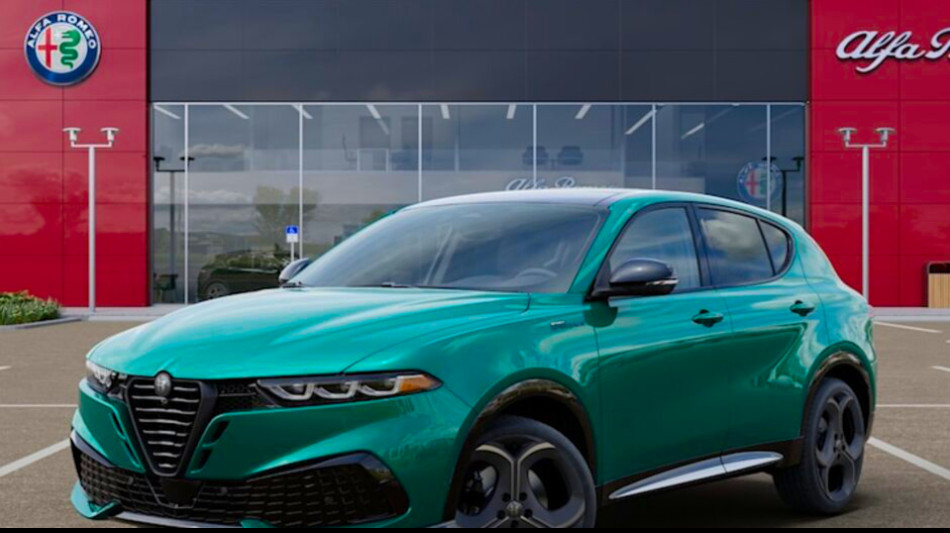
Alfa Romeo has given its Tonale compact SUV, launched in 2022, a very subtle but effective update. Three years after its debut, the designers are drawing on Alfa's typical heritage and sharpening its profile: The front now features a more pronounced, concave Scudetto radiator grille, which references the historic ‘33 Stradale’ with horizontal struts. The grille is flanked by a redesigned front apron, in which a wider air intake and side openings give the Tonale a more dynamic look. Alfa Romeo has also shortened the front overhang and widened the track, giving the car a more muscular appearance. Newly designed alloy wheels in sizes ranging from 17 to 20 inches and fresh paint finishes – including Rosso Brera, Verde Monza and Giallo Ocra – underline the refreshed look.

Interior: new colours, more comfort
The interior also benefits from ‘a little cosmetic surgery’. Alfa Romeo is expanding its range with new colours and materials. In addition to the familiar black fabric and leather upholstery, bright red leather seats or a two-tone combination of white imitation leather and black Alcantara are available for the first time. A new ‘Cannelloni’ seat design with pronounced cross-beading is reminiscent of the sports seats from the 1960s. Perforated Alcantara upholstery with white or ‘Ice’ contrast stitching is available for the Sport Speciale variant; the dashboard is also trimmed in Alcantara. LED ambient lighting in various colours, including a serpentine pattern paying homage to the coat of arms of Milan, further enhances the cockpit. In Europe, a flat rotary knob replaces the previous gear lever, while the US version retains a classic gear selector – both variants feature large aluminium paddle shifters on the steering wheel. The infotainment system includes a 10.3-inch touchscreen and a 12.3-inch digital speedometer; a 360-degree camera, wireless charging and a Harman Kardon sound system are available as options.

Change text size:

Engines: varies depending on market
The facelifted engine range remains broad in Europe. The base model is still a 1.6-litre diesel with 96 kW/130 hp and a six-speed dual-clutch transmission. Above that is a 1.5-litre four-cylinder with a 48-volt mild hybrid system, which now delivers 128 kW/174 hp thanks to software optimisation – 14 hp more than before.
 The top model remains the plug-in hybrid, whose system output drops to 199 kW/270 hp; the 1.3-litre turbo continues to work with an electric motor on the rear axle and a six-speed automatic transmission. The electric range is around 60 kilometres. Alfa Romeo is discontinuing the plug-in hybrid for the US market, replacing it with a 2.0-litre turbo four-cylinder engine with 268 hp and 400 Nm of torque. The petrol engine is coupled with a nine-speed automatic transmission and transfers its power to all four wheels as standard. An optimised steering gear with a 13.6:1 ratio and an adaptive dual damper option are designed to improve cornering behaviour.

Equipment lines and special edition
Alfa Romeo is restructuring its model family. In many markets, the Tonale will be launched as the Sprint (or Tonale Base). This version rolls on 18-inch wheels, features LED lights and a black body kit, and offers fabric seats with contrasting Biscione embroidery. Above this is the Ti (in Germany) or Veloce (in the USA), which features 19-inch wheels, a sport-tuned suspension, red Brembo brake calipers and ventilated leather seats with electric adjustment. The top-of-the-range model is the Sport Speciale, an elaborate launch edition with 20-inch Fori rims in a three-hole design, silver side skirts, black Brembo calipers, black logos and an exclusive interior in black and pearlescent Alcantara. Italian tricolour accents on the exterior mirrors and centre tunnel emphasise its origins. An adaptive damper system, a black roof, a panoramic roof and numerous assistance systems are available as options.

Market launch and prices
The refreshed Tonale will be delivered in Europe from November 2025 (as a 2026 model year). Prices are likely to remain just above €40,000. In the USA, the Tonale will launch in 2026 at around $39,745. The Sport Speciale variant will be priced accordingly higher. For Alfa Romeo, this model update is above all a signal: with subtle visual refinements, more modern technology and a tighter drive portfolio, the Tonale is set to become more attractive and boost its recently sluggish sales figures. Whether these ‘cosmetic changes’ will be enough ultimately depends on customer acceptance in a highly competitive segment. One thing is certain: the compact Italian car has a fresher look while remaining true to its roots.

Featured

New Nissan Leaf 2026 review

The name ‘Leaf’ stands like no other for the early breakthrough of electric mobility in everyday life. Now Nissan is bringing back the Leaf as a completely repositioned model – not as a classic compact car as before, but as an aerodynamically designed electric crossover in a family-friendly size. The central promise: long range, modern assistance and infotainment technology, and an entry-level price that currently stands out in the German market. At the same time, the equipment list shows that the aggressive price has not been achieved without compromises – especially in terms of charging and the winter suitability of the basic version.Pricing strategy: starting at £35,950 – and a clear focus on volumeNissan is focusing on a clear spread for the new Leaf (model year 2026): the entry-level price starts at £35,950 (recommended retail price, typically plus delivery). The variants are priced up to £48,000.Noteworthy: the smaller battery is only available in the basic version. Those who want more range and more comfort technology automatically end up with the larger battery and thus in a significantly higher price range. Although the Leaf is advertised at a ‘competitive price’, the configurations that are realistically in high demand (larger battery, more comfort) are in a price range where there is strong competition.

Rimac Nevera R: Beyond imagination

There are vehicles that define a class. And there are vehicles that define a benchmark for which there was not even a reasonable scale before. The Rimac Nevera R is just such a case: a fully electric hypercar that is not only faster than most of what we know, but whose technical logic stems more from the world of high-performance test benches, aerodynamics laboratories and control software than from classic sports car romanticism.Yet the Nevera R is not intended to be ‘just another special edition’. Rimac describes it as a counterpoint to the grand tourer concept of the original Nevera: less ‘hyper GT’, more ‘hyper sports car’. The letter R symbolises a philosophy that is rarely seen implemented so consistently in everyday life: radical, rebellious, relentlessly refined. The goal is clear – not only to achieve top speeds in a straight line, but above all to deliver a new level of quality in corners, when braking and in the feedback to the driver.

Luce: Ferrari's ingenious electric revolution

Rome is set to be the scene of a milestone that could hardly be more significant for Ferrari: on 25 May 2026, the manufacturer plans to present its first fully electric production Ferrari to the public. The name of the model has already been decided – ‘Luce’, Italian for ‘light’. And it says it all: not as a departure from tradition, but as a deliberate starting point for a future in which performance, emotion and electrification come together. Ferrari is not just talking about a new type of drive system – but about a new chapter in the brand's identity.Three phases until the world premiere – and a deliberately built-up suspense arcFerrari has designed the launch of the Luce not as a classic ‘curtain up’ moment, but as a multi-stage unveiling. After the early technical visualisation of key components, the next, strongly design-driven stage followed in early 2026: the name and interior were revealed in advance, without revealing the complete exterior. This dramaturgy is no coincidence. It signals that Ferrari does not want the Luce to be seen as merely an ‘electric model’, but rather as the start of a separate segment within its own model range – with its own character, its own design language and a clear message: electrification is not an end in itself here, but a tool for new possibilities.

Cayenne Turbo Electric 2026

With the Cayenne Turbo Electric, the Stuttgart-based sports car manufacturer is finally entering the age of fully electric SUVs. Back in 2002, the Cayenne was the model with which Porsche conquered the luxury off-road vehicle segment. With the fourth generation, a pure battery-powered vehicle is now available for the first time. Two variants will be launched in spring 2026: the Cayenne Electric and the top-of-the-range Cayenne Turbo Electric. Both feature all-wheel drive with one permanently excited synchronous motor per axle. The electric Cayennes are longer and wider than the previous models, yet still offer the characteristic silhouette with a low bonnet, curved roofline and striking fenders.Supercar-level performance and driving dynamicsIn the Turbo version, the E-Cayenne delivers a system output of up to 850 kW (1,156 hp) when the start or ‘push-to-pass’ function is activated. In normal operation, 630 kW (857 hp) is available; an additional boost of 130 kW (176 hp) can be called up for ten seconds at the touch of a button. The maximum torque is 1,500 Nm. With this power, the SUV, which weighs just under 2.72 tonnes, sprints to 100 km/h in 2.5 seconds and reaches 200 km/h in just 7.4 seconds. The top speed is 260 km/h. The standard Cayenne Electric achieves 300 kW (408 hp) in normal driving mode and 325 kW (442 hp) with the aid of Launch Control. It accelerates from 0–100 km/h in 4.8 seconds and reaches a top speed of 230 km/h. Both versions feature electronic Porsche Traction Management (ePTM), which regulates the power distribution between the front and rear axles in milliseconds.

Change text size: