The National Times - Bentley: Visions for 2026

Bentley: Visions for 2026


Bentley: Visions for 2026

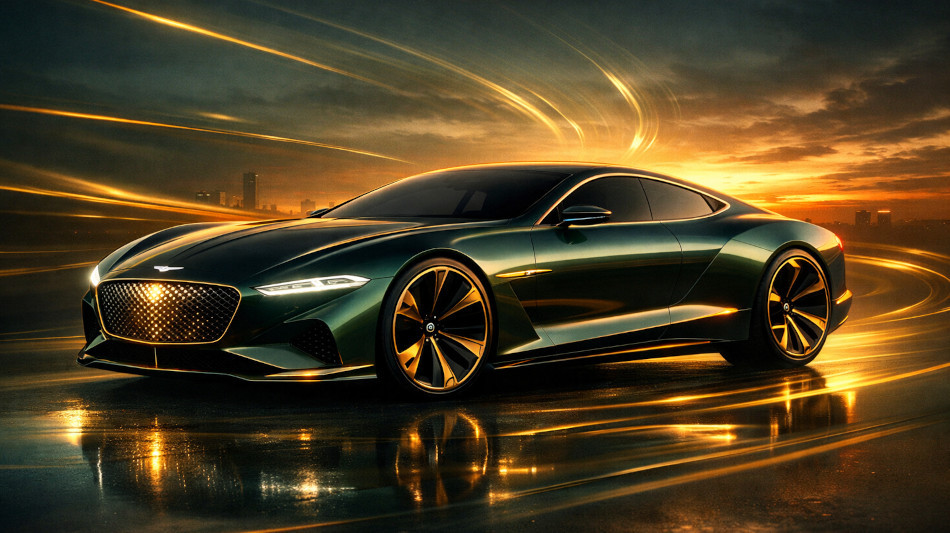
Bentley returns to its roots in 2026 with the Continental GT Supersports, one of the most extreme versions of the two-seater grand tourer ever to hit the road. A hundred years after the first ‘Super Sports’, the new Supersports remains true to its name: it will be limited to just 500 numbered units and offers the purest driving experience.

At the heart of the Supersports is the revised 4.0-litre twin-turbo V8 with enlarged turbochargers and reinforced cylinder heads. With 666 PS and 800 Nm of torque, it achieves the highest performance ever achieved in a Bentley V8. Power is transmitted to the rear wheels via an eight-speed dual-clutch transmission – a departure from the usual all-wheel drive and an expression of the purist concept.

The Supersports' performance is impressive: 0–100 km/h in 3.7 seconds and a top speed of around 310 km/h. To ensure the car remains stable at high speeds, the aerodynamics have been comprehensively optimised. A huge front splitter, side skirts, aprons and a fixed rear wing generate over 300 kilograms of additional downforce compared to the Continental GT Speed. The weight reduction extends from carbon fibre body parts to a complete titanium exhaust system; the total weight remains below two tonnes, enabling the car to achieve 1.3 g of lateral acceleration.

In the interior, Bentley has opted for a combination of carbon fibre and fine leather. The traditional rear seats have been replaced by two lower-positioned sports seats to save weight and lower the centre of gravity. As usual, customisation is possible through the in-house refiner Mulliner, with new colour and material combinations available. Orders for the Supersports will start in March 2026, with production starting later in the year. Bentley has not yet announced official prices, but experts expect them to be well into six figures.

Urban SUV – first all-electric production model
While the Supersports celebrates the petrol tradition, Bentley is simultaneously venturing into the fully electric future. The British manufacturer has announced its first all-electric SUV, currently known under the working title ‘Urban SUV’, for the end of 2026. With a length of less than five metres, it is set to be more compact than the Bentayga and create a new market segment. The manufacturer promises tailor-made luxury and a wide range of personalisation options, as well as state-of-the-art technology.

Technical details are still scarce, but Bentley confirmed at a press conference that the Urban SUV will be based on an 800-volt platform and will offer a charging capacity for a range of 160 kilometres in under seven minutes. The developers are thus aiming for industry-leading charging times. The platform is likely to come from the Volkswagen Group, as is already the case with other models in the Premium Performance Electric (PPE) modular system.

Production of the pre-series vehicles has already begun in autumn 2025, and Bentley emphasises that the Urban SUV will be designed, developed and built entirely in Crewe. The market launch is planned for the end of 2026, with the first deliveries to customers scheduled for 2027. Inside, customers can expect a new level of digital connectivity, paired with sustainable materials and the typical Bentley finish. The trade press estimates the starting price at around €140,000, which would be below the Bentayga.

Change text size:

Beyond100+ – Strategy and outlook
With its Beyond100+ strategy, Bentley is pursuing a clear path to an electrified future. The introduction of a fully electric urban SUV is part of a product roadmap that envisages at least one electrified model per year from 2026 onwards. At the same time, hybrid technology will continue to be used for years to come: the manufacturer has announced that it will keep plug-in hybrid models in its range until at least 2035 in order to offer customers a flexible choice between combustion engines, hybrids and fully electric models.

With the return of the Supersports and the debut of the Urban SUV, Bentley is committing to a dual-track strategy: on the one hand, preserving traditional values and sporting passion, and on the other, consistently implementing its electrification goals. 2026 therefore marks a turning point for the brand – a step towards the future without denying its roots.

Featured

New Nissan Leaf 2026 review

The name ‘Leaf’ stands like no other for the early breakthrough of electric mobility in everyday life. Now Nissan is bringing back the Leaf as a completely repositioned model – not as a classic compact car as before, but as an aerodynamically designed electric crossover in a family-friendly size. The central promise: long range, modern assistance and infotainment technology, and an entry-level price that currently stands out in the German market. At the same time, the equipment list shows that the aggressive price has not been achieved without compromises – especially in terms of charging and the winter suitability of the basic version.Pricing strategy: starting at £35,950 – and a clear focus on volumeNissan is focusing on a clear spread for the new Leaf (model year 2026): the entry-level price starts at £35,950 (recommended retail price, typically plus delivery). The variants are priced up to £48,000.Noteworthy: the smaller battery is only available in the basic version. Those who want more range and more comfort technology automatically end up with the larger battery and thus in a significantly higher price range. Although the Leaf is advertised at a ‘competitive price’, the configurations that are realistically in high demand (larger battery, more comfort) are in a price range where there is strong competition.

Rimac Nevera R: Beyond imagination

There are vehicles that define a class. And there are vehicles that define a benchmark for which there was not even a reasonable scale before. The Rimac Nevera R is just such a case: a fully electric hypercar that is not only faster than most of what we know, but whose technical logic stems more from the world of high-performance test benches, aerodynamics laboratories and control software than from classic sports car romanticism.Yet the Nevera R is not intended to be ‘just another special edition’. Rimac describes it as a counterpoint to the grand tourer concept of the original Nevera: less ‘hyper GT’, more ‘hyper sports car’. The letter R symbolises a philosophy that is rarely seen implemented so consistently in everyday life: radical, rebellious, relentlessly refined. The goal is clear – not only to achieve top speeds in a straight line, but above all to deliver a new level of quality in corners, when braking and in the feedback to the driver.

Luce: Ferrari's ingenious electric revolution

Rome is set to be the scene of a milestone that could hardly be more significant for Ferrari: on 25 May 2026, the manufacturer plans to present its first fully electric production Ferrari to the public. The name of the model has already been decided – ‘Luce’, Italian for ‘light’. And it says it all: not as a departure from tradition, but as a deliberate starting point for a future in which performance, emotion and electrification come together. Ferrari is not just talking about a new type of drive system – but about a new chapter in the brand's identity.Three phases until the world premiere – and a deliberately built-up suspense arcFerrari has designed the launch of the Luce not as a classic ‘curtain up’ moment, but as a multi-stage unveiling. After the early technical visualisation of key components, the next, strongly design-driven stage followed in early 2026: the name and interior were revealed in advance, without revealing the complete exterior. This dramaturgy is no coincidence. It signals that Ferrari does not want the Luce to be seen as merely an ‘electric model’, but rather as the start of a separate segment within its own model range – with its own character, its own design language and a clear message: electrification is not an end in itself here, but a tool for new possibilities.

Cayenne Turbo Electric 2026

With the Cayenne Turbo Electric, the Stuttgart-based sports car manufacturer is finally entering the age of fully electric SUVs. Back in 2002, the Cayenne was the model with which Porsche conquered the luxury off-road vehicle segment. With the fourth generation, a pure battery-powered vehicle is now available for the first time. Two variants will be launched in spring 2026: the Cayenne Electric and the top-of-the-range Cayenne Turbo Electric. Both feature all-wheel drive with one permanently excited synchronous motor per axle. The electric Cayennes are longer and wider than the previous models, yet still offer the characteristic silhouette with a low bonnet, curved roofline and striking fenders.Supercar-level performance and driving dynamicsIn the Turbo version, the E-Cayenne delivers a system output of up to 850 kW (1,156 hp) when the start or ‘push-to-pass’ function is activated. In normal operation, 630 kW (857 hp) is available; an additional boost of 130 kW (176 hp) can be called up for ten seconds at the touch of a button. The maximum torque is 1,500 Nm. With this power, the SUV, which weighs just under 2.72 tonnes, sprints to 100 km/h in 2.5 seconds and reaches 200 km/h in just 7.4 seconds. The top speed is 260 km/h. The standard Cayenne Electric achieves 300 kW (408 hp) in normal driving mode and 325 kW (442 hp) with the aid of Launch Control. It accelerates from 0–100 km/h in 4.8 seconds and reaches a top speed of 230 km/h. Both versions feature electronic Porsche Traction Management (ePTM), which regulates the power distribution between the front and rear axles in milliseconds.

Change text size: